

Latest
Volume 13 Issue 1
Published on
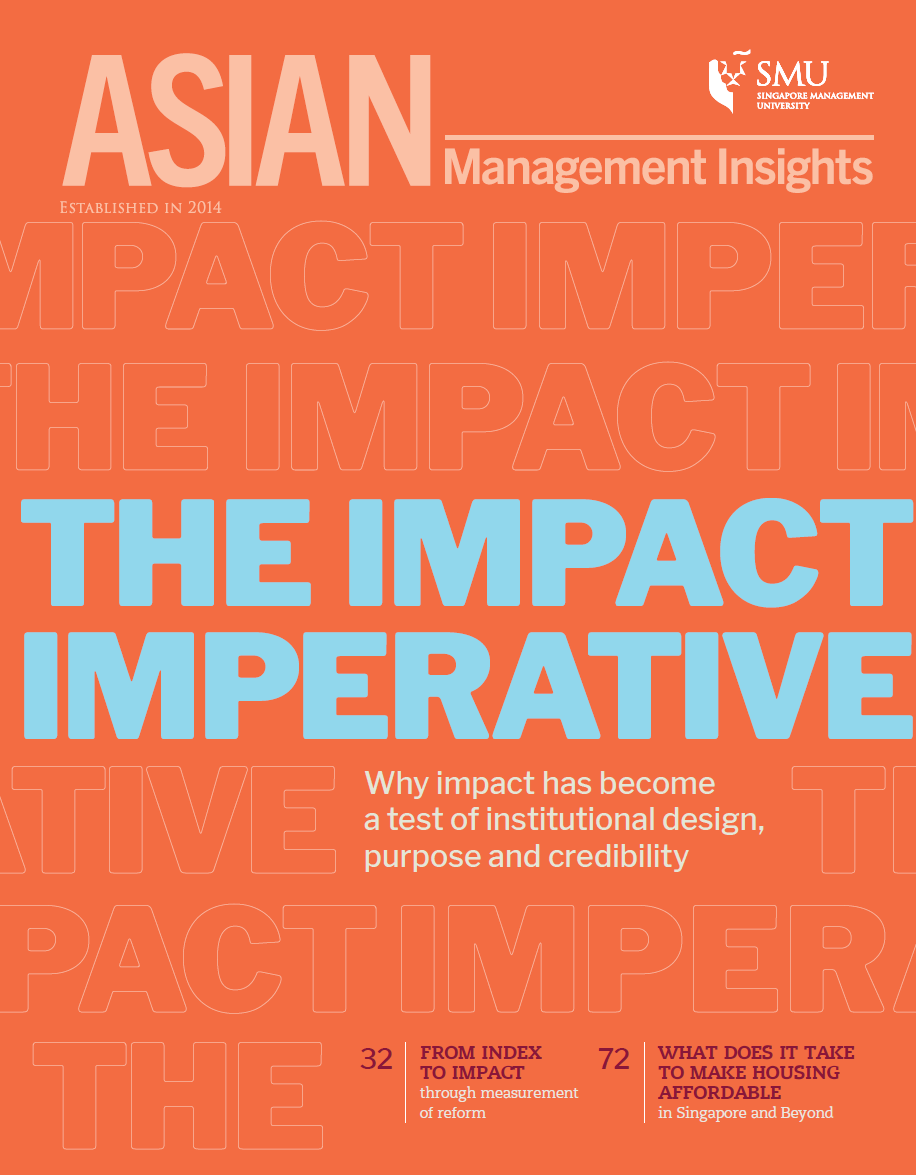
Across Asia—and increasingly around the world—we are entering what can only be described as an age of impact.
Across Asia—and increasingly around the world—we are entering what can only be described as an age of impact.

For organisations to drive real change, they must treat impact as a strategic commitment and reshape internal structures to support it. An interview with Michael Rich, President Emeritus of RAND Corporation.
Why impact has become a test of institutional design, purpose and credibility.

As priorities evolve, sustainability continues to shape key business decisions for organisations. An interview with Helge Muenkel, Chief Sustainability Officer at DBS.

The A*STAR Infectious Diseases Labs offers a model for how organisations can move from ad-hoc crisis response to sustained, shared preparedness.

Why business leaders should watch Vietnam’s subnational reform experiment closely.
How collaboration—supercharged by AI—can turn purpose into performance, and performance into accountability.

From wellness myths to financial hype, the real risk is not just misinformation—it’s misinformed decision-making. When confidence becomes a proxy for credibility, strategies and sensibility drift. Here’s how leaders can raise the evidence bar and institutionalise independent challenge.
Institutes of higher learning do more than generate knowledge. At their best, they connect partners, evidence, policy and capability to make social impact more credible, cumulative and durable.
By Julian Tang
Ditch the proverbial laundry list and build impactful reports with evidence of change that leaders, partners and the public can trust and act on.

After a decade-long career in consumer brand MNCs, Nivedita Venkateish began her own business to help seniors tackle urinary incontinence.

Professor Phang Sock Yong’s body of work has shaped conversations around housing affordability both in Singapore and abroad—helping policymakers manage land, supply, finance and market rules as one integrated system.
As NGOs lack formal authority, their influence depends on legitimacy, which can be contested at scale online. Leaders must treat social media as a governance decision, with clear scope, speaking authority and response protocols.