

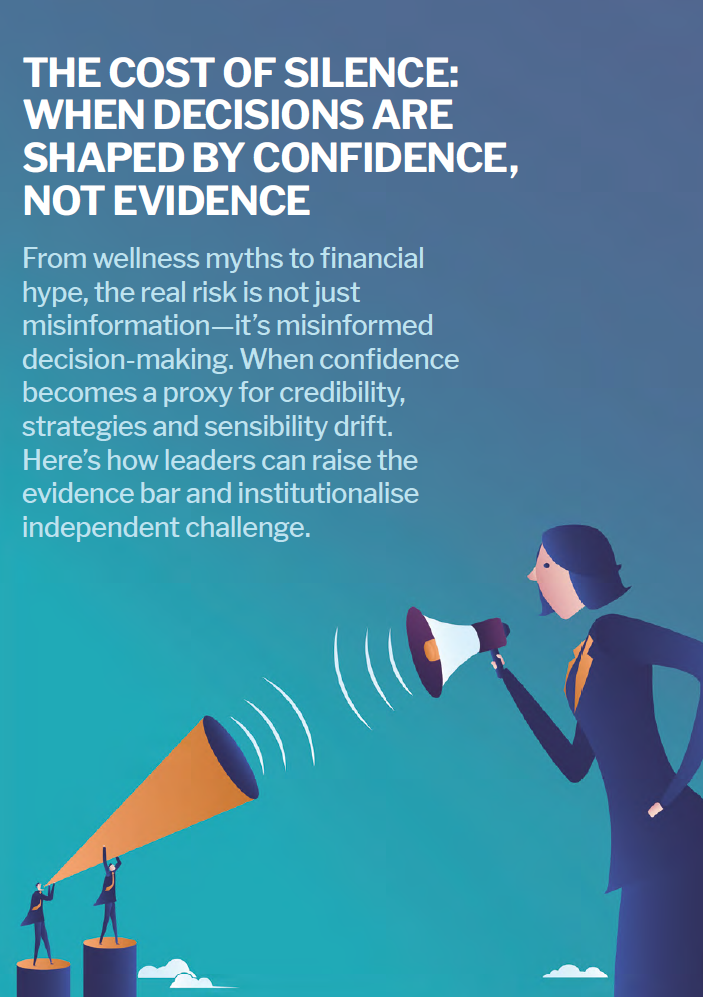
From wellness myths to financial hype, the real risk is not just misinformation—it’s misinformed decision-making. When confidence becomes a proxy for credibility, strategies and sensibility drift. Here’s how leaders can raise the evidence bar and institutionalise independent challenge.
1. Decisions guided by the confidence of faux experts, rather than robust evidence, can create substantive risks for organisations. 2. Although academics can provide expert guidance, there are gaps preventing their voices from being heard. 3. Universities should develop strategies to make expertise easier to access and encourage academics to contribute to public discourse. |
In 2024, a woman and her newborn child died after attempting an unassisted ‘freebirth’ in nature, a practice promoted by wellness influencers who positioned natural birth as empowering while dismissing medical expertise as fearmongering and interventionist.1 Charismatic online personalities, often with no qualifications, can persuade large audiences to see experts—in this case, obstetricians, midwives and evidence-based prenatal care—as obstacles rather than safeguards.
Health is an especially stark arena for this problem, but it is certainly not the only one. Misinformation also circulates around sunscreen and “natural” sun protection, despite repeated debunking by institutions such as the Skin Cancer Foundation2 and Stanford Medicine.3 The same pattern appears in finance: “finfluencers” can deliver confident opinions with the sheen of authority, encouraging decisions that are poorly anchored in evidence. In Indonesia, two such influencers, Doni Salmanan and Indra Kesuma, were reported to have played roles in schemes where followers lost substantial sums while they benefitted.4,5
In Singapore, too, financial content often blends investing tips with self-optimisation language—promising to “unlock your superpowers” or “fast-track personal transformation”—despite thinly substantiated evidence, no credible guarantee of results and often hefty price tags. In the process, evidence, uncertainty and tradeoffs are compressed into catchy, confidence-heavy narratives.
THE RISE OF “CONFIDENCERS”: THE RISKS LEADERS CANNOT IGNORE
These incidents signal a larger problem: the information landscape is shaped by social media, and it rewards what is clear, fast, emotionally resonant and ‘loud’—not what is careful, conditional and evidence-led. Over time, decisions will be driven by those who sound the most convincing rather than those with credible claims.
Call these people “confidencers”: individuals who can project authority with charisma and strong narratives. They are not limited to influencers: salespeople, consultants and vendors can also be confidencers.
Across these cases, the same misattribution occurs: visibility is treated as credibility, even though reach and engagement are weak proxies for integrity, competence or societal impact.
A useful way to understand this pattern is to follow the incentives. For example, influencers monetise attention; their success depends on engagement, not accuracy. Algorithms often reward controversy over nuance and evidence. Consultants are paid to provide direction under uncertainty; confidence is part of the product, and there is an understandable pressure for decisive recommendations. Sales teams are rewarded for persuasion and conversion: balance and caveats may not be the priority. When managers base their decisions primarily on those voices, they risk building strategies on foundations optimised for engagement and contracts rather than evidence. None of this implies bad faith; it is simply how incentive systems shape communication.
Academic experts, in contrast, are socialised into a different discipline: claims are expected to be contested, limitations are documented and reputations are built (or lost) on accuracy and evidence. That does not automatically make academic voices “right”—academia has its own blind spots and biases—but it often produces a healthier default posture for high-stakes decision-making: show your working, name your uncertainty and separate what you know from what you suspect.
WHY ACADEMIC EXPERTS ARE NOT HEARD MORE
In my experience, organisations struggle to incorporate academic expertise for reasons that are often about translation and alignment.
First, there is a perceived confidence gap. Academics are trained to be cautious and measured, because research results are rarely bulletproof. Even when the evidence is strong, academic papers often end with a long list of limitations, acknowledging the flaws of their research. For managers, that candour can be mistaken for hesitancy, when it is more accurately a form of intellectual honesty.
Second, there is a communication gap. Academic knowledge often arrives in forms that are hard to act on quickly: long papers, specialised language and arguments structured for peer scrutiny rather than executive decisions. Many scholars are not trained to produce crisp “decision-ready” outputs on demand—one-page syntheses, trade-off statements or clear options with conditions. Even when they have the substance, many are neither comfortable nor trained to deliver elevator pitches.
And then there is a scope gap. Leaders and policymakers must integrate across different domains, ranging from strategy and finance to delivery constraints and stakeholder expectations. Academics, by design, tend to specialise, “digging deep into narrow wells”. That depth is valuable, but it can make it harder to zoom out to the systems level where many leadership decisions are made.
Finally, there is an incentive gap. In most universities, publishing, grants and academic recognition remain the primary currencies. Academics often do not have incentives to share their expertise with the general public. When time is scarce, what gets measured and rewarded tends to win.
The cumulative effect is predictable: organisations default to the voices that are easiest to access, easiest to understand and easiest to act on—especially under pressure. But that convenience can be expensive. How then can we overcome these gaps?
WHAT ORGANISATIONS AND THE PUBLIC CAN DO TO PREVENT “CONFIDENCE CAPTURE”
One starting point is scrutinising the source. In an overloaded information environment, source credibility becomes an important filter. Who is making the claim? What is their track record? Do they have incentives to exaggerate certainty or oversell applicability to your context?
Next, we should scrutinise the evidence in a way that is proportionate to the decision. Not every decision requires a literature or peer review, but higher-stake choices—particularly those affecting health, finances, safety or the wellbeing of others—should trigger a higher evidence bar. What type of data substantiates the claim? Who collected it, analysed it and over what timeframe? What are the limitations of the research? An opinion is not a fact, and credibility rests on whether claims can be checked, not merely asserted. In this regard, academic work is often useful precisely because it is designed to withstand scrutiny.
It also helps to get comfortable with calibrated language. We do not need academics to sound like salespeople; we need clarity about what is known, what is uncertain and what would change the recommendation. The academic “yes, but” mindset is not a weakness; it is often the beginning of good governance.
Finally, organisations can institutionalise independent challenge rather than leaving it to individual judgement. Build routines that bring in domain experts like academics early, invite counterarguments and stress-test assumptions through external advisors, structured reviews or “red team” exercises—where a designated group is tasked to probe weaknesses, surface failure modes and argue the strongest case against the proposal. The aim is not to slow decision-making, but to reduce the risk that confidence becomes a substitute for evidence.
WHAT UNIVERSITIES CAN DO TO MAKE EXPERTISE EASIER TO USE
Universities also have agency here. If the ambition is societal impact—real-world change, not just outputs—then expertise must be made more accessible and applicable to the organisations that need it.
University leaders can treat societal impact as a leadership agenda, not an optional add-on. For instance, Singapore Management University’s (SMU) 2030 strategy, “Shaping Impact, Transforming Lives,” is a testament to the centrality of societal impact at the institutional level.
Universities can shift scholarly culture and incentives so that engagement, translation and public contribution are not merely applauded but meaningfully recognised. Much university work is funded by taxpayers. A credible impact agenda makes the “give back” logic operational: not by turning academics into marketers, but by rewarding those who translate knowledge responsibly and effectively. It requires a shift in academics’ mindsets, often triggered by a change in how success is measured.
Universities should also build impact skills as a professional capability. Translation is a craft: writing for non-academic audiences, framing evidence for decisions, communicating uncertainty and working across disciplines and stakeholders. In my role as Associate Dean at SMU’s Lee Kong Chian School of Business, I have launched an “Impact Upskilling Series” to support colleagues interested in strengthening their societal contribution. Done well, this kind of investment helps academics stay rigorous and evidence-led while extending the reach of their expertise beyond the university.
SILENCE IS TOO COSTLY
The price of silence is not only the misinformation amplified by social media. It is also the wasted resources and missed opportunities driven by confidence and charisma over reliable insights and rigorous testing.
In an era where anyone can sound like an expert, genuine expertise becomes a competitive advantage—but only if organisations build the habits and structures to access it, interpret it and apply it. The goal is not to replace confidence with caution. It is to pair confidence with evidence, and to make sure decisions are shaped by what is most accurate, not merely what is the loudest.
Sabine Benoit
is a Professor of Marketing (Practice) and Associate Dean (Impact) at Lee Kong Chian School of Business, Singapore Management University. She specialises in retail technology, and her work has been published in leading international journals. She has also collaborated with several companies for her research. Sabine is enthusiastic about making her research accessible to non-academic audiences, publishing her content on platforms like YouTube and LinkedIn.
For a list of endnotes to this article, please click here.