

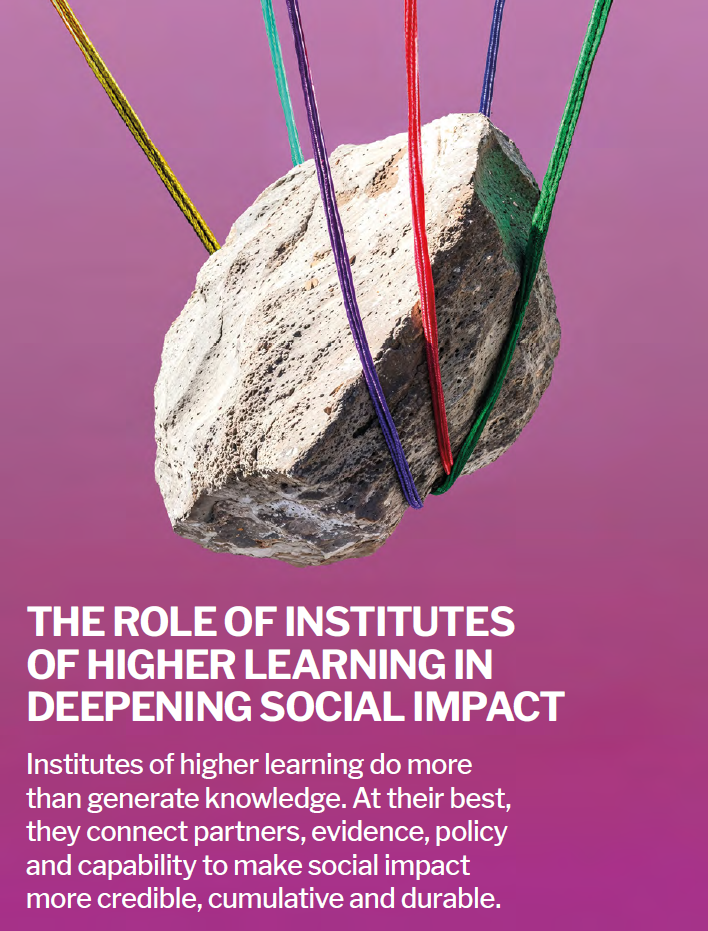
Institutes of higher learning do more than generate knowledge. At their best, they connect partners, evidence, policy and capability to make social impact more credible, cumulative and durable.
1. Social issues often affect society at large, requiring coordinated efforts between different stakeholders. 2. Institutes of higher learning provide a shared space to enable partnerships and foster understanding of issues. 3. Research and expertise from institutes of higher learning then bolster capabilities for sector actors to address social issues directly. |
Institutes of Higher Learning (IHLs) have outgrown their traditional role as solely centres that confer knowledge and credentials. Increasingly, they function as civic anchor institutions—helping societies translate knowledge into action, and action into learning. Social impact is rarely achieved through one-off projects; it relies on an operating rhythm that connects partners, evidence, policy, delivery and capability over time. Strategically positioned at the intersection of research, society and public decision-making, their reach extends into policy, industry and community. They are thus primed to be powerful drivers of social impact.
The process through which IHLs facilitate social impact can be described as a four-stage cycle. It begins with convening cross-sector partners around shared goals. IHLs then help define and frame complex problems so interventions target the right constraints. Once the direction is determined, evidence is generated to inform policy and programme design, with evaluation of what works (and what does not). IHLs then build the capacity to sustain change. Each stage strengthens the next, creating a reinforcing loop of learning, action and improvement.
ENCOURAGING CROSS-SECTOR COLLABORATION1
Social issues seldom suffer from a lack of opinions. They affect society broadly, its effects rippling across different sectors with varying intensity. They tend to spark intense debate among stakeholders, as they often hold divergent viewpoints. Yet it is from these differing opinions that the most effective solutions are born—nuanced approaches to complex issues require a range of perspectives. Cross-sector collaboration is essential, but often difficult in practice. Differences in organisational culture, shifting priorities and funding constraints can easily create friction between actors, pushing them back into silos and limiting their ability to adapt or respond to emerging needs.
This is where IHLs come in. Because cross-sector collaboration is both essential and difficult, IHLs have increasingly stepped into a convening role—bringing stakeholders into dialogue on more equitable terms. As neutral intermediaries, they help bridge divides between stakeholders and align philanthropic capital, public budgets and local knowledge around shared, place-based goals rather than fragmented, short-term projects. Done well, convening is not simply about “bringing people together”; it is about creating the conditions for joint problem-solving, including trust, shared language and workable governance.2
A prominent example is the Bloomberg Harvard City Leadership Initiative.3 A collaborative effort between Bloomberg Philanthropies, Harvard Business School and the Harvard Kennedy School of Government, the initiative combines peer-reviewed research with applied training and curriculum development. Researchers, students and city residents are brought together to support municipal leaders in tackling real-world problems. Since 2017, the initiative has supported 9 cohorts of mayors and senior city officials, equipping them with the skills, networks and tools necessary to respond to rapidly evolving social issues. Through the initiative’s innovation track alone, 57 towns and cities across the United States have since participated, engaging 604 public-sector employees and over 4,700 residents.
Through initiatives such as these, IHLs can act as social incubators: not as the “owners” of solutions, but as institutions that help diverse actors co-create and scale them.
DEFINING AND FRAMING SOCIAL ISSUES
Every solution to a social ill begins with a problem statement—which often determines which solutions or innovations are pursued. The same social condition can generate very different interventions, depending on whether it is treated as a skills deficit, a labour-market failure, a health issue, a housing constraint or an access problem. Poor problem statements narrow the option set too early; a well-framed one clarifies what must change, for whom and under what constraints. Poverty, for example, if framed as a lack of education, naturally points to education as the solution. However, if available data finds that it is, instead, the result of a weak labour market, it demands a very different set of interventions.
IHLs can strengthen problem definition by slowing down the rush to solutions and introducing evidence-informed sense-making.
The Impact Economy Policy Labs held at the London School of Economics’ Marshall Institute illustrates this.4 The Labs provide a neutral setting for participants to discuss issues on relatively equal footing—encouraging openness, trust and collaboration. While the Labs bring together diverse actors, their distinctive contribution lies in how they approach problem definition.
Rather than beginning with a predetermined problem definition, sessions start with a shared exploration of complex social challenges. Frontline practitioners bring delivery realities, policymakers contribute institutional constraints and grassroots leaders offer lived insights that formal processes can overlook. Participants have described this approach as “unusual and refreshing,” particularly when compared to conventional policymaking, where complex issues are often addressed in isolation or only after solutions have already been formulated.
By deliberately creating structured spaces to reexamine assumptions, initiatives such as the Impact Economy Policy Labs enable stakeholders to revisit and redefine social issues from multiple vantage points. In doing so, policies and interventions are more likely to target root constraints, reflect social realities and be supported by a broader sense of shared responsibility.
GENERATING RESEARCH THAT INFORMS PUBLIC POLICY AND INTERVENTIONS
With problems clearly defined, IHLs can contribute with where they are strongest: producing and curating sound evidence that informs policymaking and intervention design across domains such as health, education, climate and social welfare. Through systematic data collection, rigorous testing of interventions and careful evaluation of outcomes, IHLs provide policymakers, service providers and funders with reliable insights into what works, what does not and why. In an era marked by misinformation and polarised debate, this evidence-based knowledge is essential for strengthening the credibility, effectiveness and accountability of public policy and social programmes.
In Singapore, IHLs have invested heavily in advancing our understanding of social change within ageing populations over the past three decades. Institutions such as the Duke-NUS Centre for Ageing Research and Education (CARE)5 and Singapore Management University’s (SMU's) Centre for Research on Successful Ageing (ROSA)6 have built a robust body of evidence on ageing and later-life wellbeing. ROSA’s Singapore Life Panel, comprising over 12,500 active participants and nearly 900,000 surveys completed over the past decade, supports a more holistic view of ageing that extends beyond clinical health to include social connection and psychological well-being.
This depth of longitudinal data can shape policy deliberation and programme design, providing clear evidence to facilitate discussion on overlooked issues. In January 2026, Singapore’s Minister of Health Ong Ye Kung discussed the issue of loneliness and psychological distress among socially isolated older persons, citing a CARE study from 2018. Evidence of this nature can sharpen parliamentary debate and help agencies and service providers refine targeting. Related work by IHLs may also have contributed to the design and scaling of initiatives such as the Silver Generation Office,7 the Agency for Integrated Care (AIC) and more than 200 Active Ageing Centres—each delivering outreach services to nearly 30,000 socially isolated older persons.8
IHLs can also spark national conversations on social issues, including age-related inequality. The Institute of Policy Studies (IPS), for instance, has highlighted rising experiences of ageism in the workplace among those aged 51 to 65, contributing to debates surrounding the Workplace Fairness Bill (2025), which seeks to protect workers from discriminatory practices, including those based on age.9 Taken together, these efforts underscore the importance of building rigorous bodies of knowledge to better inform, refine and galvanise social impact initiatives and policy change across multiple stakeholders.
Increasingly, research is conducted in close partnership with practitioners and policymakers. When IHLs collaborate directly with those designing and delivering programmes, it creates feedback loops where evidence, funding and policy reinforce one another for long-term, systemic change. A study conducted in collaboration with SMU’s Lien Centre for Social Innovation (LCSI) and The Food Bank Singapore, for example, found that 10% of households experienced food insecurity in 2019, with significant implications to physical and mental health. The study recommended addressing misalignment of food support resources through geographic mapping and better multi-sector coordination.10 It was also cited in parliamentary debates on the Food Safety and Security Bill in 2025. This is a useful pattern: In translating research into operational recommendations, IHLs enable the implementation of evidence-backed solutions for policy and delivery actors.
INSPIRING LONG-TERM, STRUCTURAL CHANGE
IHLs can also help charities, funders and governments move beyond surface responses to social problems by analysing underlying causes and system dynamics. Using systems thinking, longitudinal data analysis and participatory research, IHLs can support shared theories of change and meaningful indicators of success. This alignment ensures that day-to-day programmes and interventions contribute to longer term structural outcomes rather than short-lived gains.
From this systems-level vantage point, IHLs are well positioned to support the design and testing of more creative, context-sensitive solutions that challenge existing processes and social practices. Across Asia, this has translated into concrete health innovations led or enabled by universities. At the University of the Philippines, the Programme for Social Innovations and Entrepreneurship in Health (SIHI) has, since 2017, spearheaded initiatives such as the National Telehealth System, Partners in Leprosy Action and the Inter-Island Health Service Boat Project, expanding access to healthcare in underserved communities.11
Similarly, in Thailand, Mahidol University’s Faculty of Public Health fosters innovation by convening national hackathons that surface solutions from emerging scientists. One such innovation, Cow Eco+, a traditional medicine-based digestive, has demonstrated great potential in reducing methane emissions from dairy farms—an important source of global greenhouse gas emissions.12 These examples illustrate how systemic, creative interventions are often made possible by the analytical rigour, interdisciplinary expertise and experimental capacity embedded within IHLs.
Nevertheless, social impact does not stop at well-designed interventions. Lasting, structural change depends on continual learning. IHLs deepen impact when they provide rigorous evaluation that tests assumptions over time and feeds findings back into programme design. Through this continuous feedback loop, IHLs help ensure that interventions remain relevant, effective and responsive to changing social conditions. This is where impact assessment functions less as a verdict and more as a learning mechanism.
LCSI, for instance, has published impact assessments for the corporate sector, including Impact Assessment of Uniqlo’s ‘Neighbours Helping Neighbours’ Pilot Programme (2025)13 and Impact Assessment of Employment at Telunas Resorts: A Case Study (2025). These studies go beyond measuring success or failure; they surface limitations, generate actionable recommendations and use insights to refine programme design. In this way, impact assessments become not an endpoint, but a feedback structure that enables continuous improvement and helps scale what works towards long-term systemic change.
BUILDING CAPACITY FOR A SUSTAINABLE FUTURE
Finally, as civic anchor institutions, IHLs create social impact by strengthening the capabilities of non-profit and public-sector partners. Through training, technical assistance and leadership development in areas such as data literacy, governance and organisational strategy, they help local organisations move from delivering programmes to building sustainable, high-impact institutions capable of addressing complex social challenges at scale.
The Marshall Institute’s 100x Impact Accelerator programme is one example.14 Designed as a philanthropic cooperative, the programme brings together capital, mentoring and a shared commitment to systemic change. Through a structured 12-week programme, it supports a new generation of “social unicorns”, that is, early-stage organisations with the potential to create positive impact at the scale of billions. Participants are guided in refining their scaling strategies, strengthening leadership capacity and articulating their impact, while also gaining a platform to connect with philanthropists, funders, governments and the media.
The programme spans eight key research and impact priorities, from climate and health to education, social cohesion and democratic resilience. Several Asian organisations have gone on to sustain meaningful impact through the Accelerator, including Taleemabad, a Pakistani initiative which strengthens school curricula; Karya, an Indian initiative that has created ethical digital work opportunities for over 30,000 rural women; and Labhya, an Indian non-profit that has supported education quality programmes reaching 2.4 million children and 150,000 teachers across more than 22,000 schools.
In Singapore, LCSI is currently involved in training and consultancy for 24 charities over 2 years to build their impact measurement and innovation capabilities supported by the Tote Board. This illustrates a broader point: philanthropic capital can be channelled through IHLs not only to fund programmes, but to strengthen the impact sector’s capacity to measure, learn and improve.
Capacity building also happens through education itself. As evidence has accumulated on climate risk, social inequality and ethical failures across sectors, themes such as sustainability, ethics and social responsibility have moved from the margins to the core of many curricula.
By integrating research findings back into pedagogy and curriculum design, IHLs strengthen capacity at its source: the people who will go on to lead institutions, design policies and deliver services. In this way, educational innovation becomes a form of capacity building in its own right, closing the loop between research, practice and the preparation of the next generation to sustain and extend social impact.
THE CYCLE OF IMPACT
In sum, IHLs can be said to be engines of social change. From convening diverse stakeholders and framing complex social issues to generating rigorous research, translating evidence into interventions and policy, and building the capacity of both organisations and students, IHLs operate across a continuous cycle of impact.
The strategic value of IHLs is that they can hold this cycle together. They can connect partners, evidence, implementation and education in ways that individual charities, agencies or funders often cannot sustain alone. In a world of increasingly interconnected and complex challenges, IHLs are uniquely positioned to turn ideas into action—and action into lasting change.
Steve Loh
is the executive director of Lien Centre for Social Innovation (LCSI), Singapore Management University. LCSI provides research and evidence-based thought leadership, impact consulting and capacity building to government, foundations, philanthropists and on-profits with the goal of bettering practice and policy at scale.
Janna Wong
is a research consultant at LCSI.
For a list of references to this article, please click here.