


Why business leaders should watch Vietnam’s subnational reform experiment closely.
1. The Provincial Competitiveness Index (PCI) provides a comparison of economic governance across Vietnam’s provinces, highlighting both development trends and the business environment. 2. Measurement of reform through feedback from local firms lent credibility and transparency to the index, making it a powerful tool for advocating policy change. 3. As Vietnam’s challenges evolve, the PCI is expanding beyond provincial benchmarking to assess national reform resilience and governance quality. |
Vietnam is in the middle of one of the most ambitious subnational governance restructurings in Asia. To streamline public administration, reduce duplication and improve service delivery, the government has embarked on a sweeping programme of provincial and administrative mergers.
Sixty-three provinces are being consolidated into 34;1 commune boundaries redrawn; local leaders replaced with centrally rotated appointees; and bureaucratic hierarchies compressed with the removal of the district tier of government. For Hanoi, the stated objectives are clear: leaner government, better governance and a stronger foundation for long-term growth.
For business leaders, however, the near-term implication is less straightforward: heightened institutional uncertainty at the level that often matters most. In Vietnam, provincial governments shape the day-to-day operating environment. They issue licenses, allocate land, oversee inspections, provide local services and infrastructure and interpret national regulations in practice. When provinces merge, firms will want to know which administrative norms will prevail, whether reform-oriented practices will be preserved or diluted and whether service delivery becomes more efficient —or simply more centralised, slower and less transparent.
These are not academic concerns. Investors making long-term commitments—building factories, developing industrial parks or integrating Vietnamese suppliers into global value chains—must form expectations about how local institutions will function five, ten or even 20 years from now. Administrative restructuring without credible measurement leaves firms navigating reform by rumour and anecdote.
Vietnam, nonetheless, is unusually well equipped to manage this transition. For more than two decades, it has maintained a uniquely granular and trusted tool for tracking subnational governance performance: the Provincial Competitiveness Index (PCI). As provinces merge and administrative boundaries shift, the PCI offers something rare in emerging markets—systematic, longitudinal evidence on how local governance actually affects business operations.
Indeed, many of the PCI’s recommendations over the past two decades encouraged the very streamlining and pro-private sector reforms that the government is now advancing. As PCI authors have long maintained, they aggregate the voice of Vietnam’s nearly one million private, small and medium-sized enterprises to strengthen their voice in policymaking. The radical reforms are a sign of the project’s remarkable success in this endeavour.
Today, the PCI is entering its most consequential phase. Originally designed to measure differences in provincial economic governance, it has evolved into a central reference point for policymakers, investors and business managers alike. As Vietnam consolidates its provinces and intensifies its anti-corruption campaign, the PCI provides a critical lens for understanding where reform is real, where it is rhetorical and where long-term opportunities lie.
WHAT IS THE PCI AND WHY SHOULD EXECUTIVES CARE?
The PCI is an annual, survey-based assessment of economic governance across Vietnam’s provinces. It is not a compliance checklist nor a perception index. The PCI is built from firm-level experience—how local rules are applied in practice, not how they are meant to work on paper.
Unlike perception indices or compliance checklists, the PCI is grounded in the lived experiences of firms. Each year, 10,000 domestic and foreign private enterprises, selected through random sampling, answer detailed questions about how provincial governments actually behave: how long it takes to register a business, how predictable regulations are, how easy it is to access land, the quality of the local labour force and business support services and whether informal payments are required to get things done.
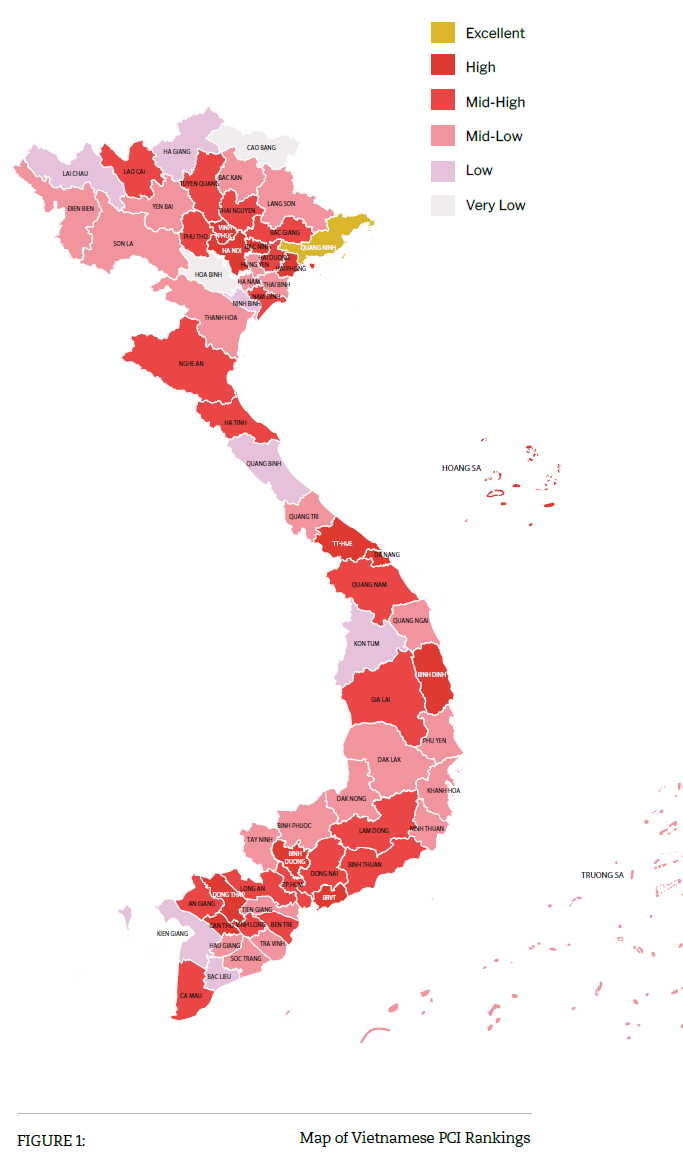
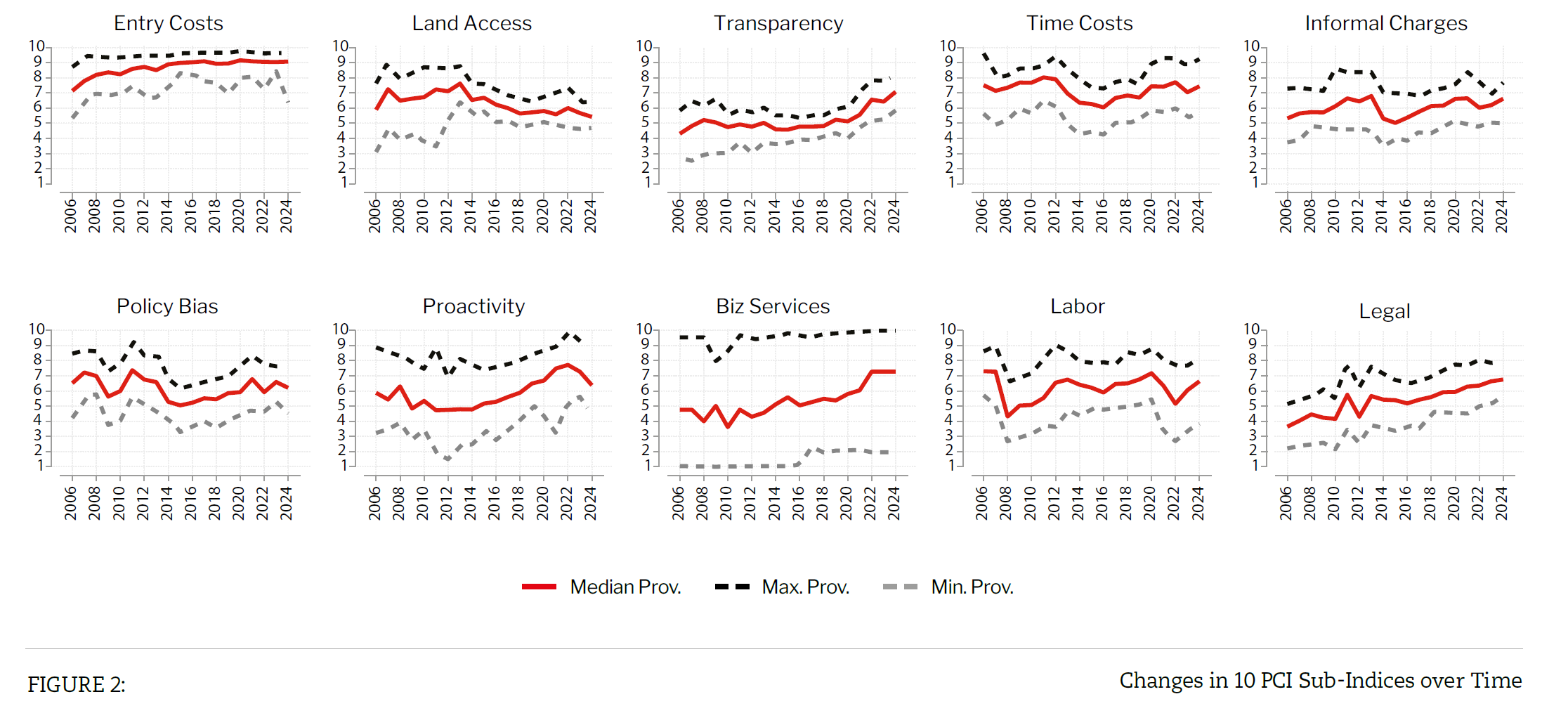
The PCI aggregates these responses into a composite score and ranking built from multiple sub-indices (refer to figure 1). These cover issues that matter directly to business strategy: entry costs, transparency, time burdens, informal charges, legal dispute resolution, labour training and—critically—the proactivity of local leadership in solving problems for firms. A high-performing province is not simply one with good laws on the books, but one where officials use their discretion to facilitate, rather than obstruct, private-sector activity (refer to figure 2).
For executives, the value of the PCI lies in three areas. First, it provides a comparative map of subnational risk within Vietnam. Differences between provinces can sometimes be as consequential as differences between countries, especially when it comes to transparency of business information and exposure to informal charges (the Vietnamese euphemism for bribery).
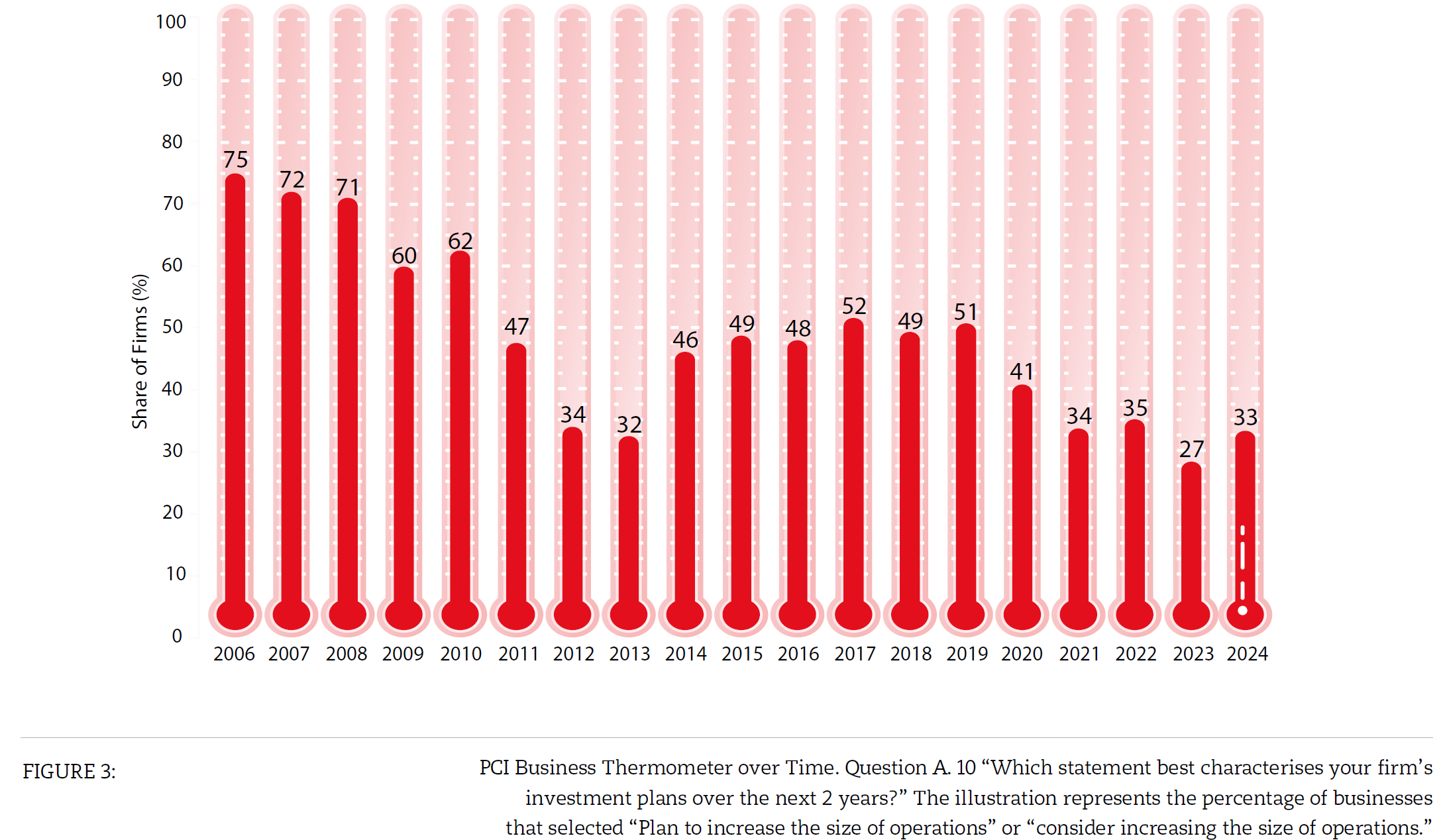
Second, it offers insight into the trajectory of reform. Because the PCI is published annually and uses a consistent methodology, it reveals whether governance improvements are sustained or short-lived. This is supplemented by an annual business thermometer that charts the willingness of private firms to expand over time (refer to figure 3).
Third, it functions as a signalling device. Provinces that take the PCI seriously tend to be those where leadership is responsive, reform-oriented and attentive to investor constraints and concerns.
In an era of provincial mergers, those signals matter even more. As administrative units combine, historical PCI performance can help firms anticipate which governance practices are likely to dominate—and where integration risks may be higher. Measurement does not eliminate uncertainty, but it can materially reduce blind spots at the point where investment decisions are made.
WHY WAS THE PCI CREATED? A TOOL TO SOLVE VIETNAM’S DECENTRALISATION DILEMMA
To understand why the PCI matters today, it helps to revisit the problem it was originally designed to solve. Since the launch of the reforms in the late 1980s, Vietnam has pursued a distinctive model of decentralised economic governance. While remaining a unitary state politically, it delegated substantial authority over economic administration to provincial governments. Provinces gained discretion over licensing, land allocation, taxation, inspections and the implementation of national laws.
This decentralisation helped fuel rapid growth, but it also created wide variation. Some provinces embraced private enterprise, streamlined procedures and courted investors aggressively. Others remained cautious, opaque or openly hostile to domestic private firms, often ideologically favouring state-owned enterprises (SOEs) or being captured by connected business conglomerates. National legislation, which drew heavily on international exemplars, often looked impressive on paper, yet its local implementation differed dramatically across the country.
By the early 2000s, that divergence had become a binding constraint on further development. Businesses complained that success depended less on national policy than on provincial interpretation and implementation. Technocratic reformers inside the system lacked credible data to diagnose where implementation was failing. Investors, meanwhile, had little systematic information to guide location decisions beyond informal networks. The PCI emerged as a response to this implementation gap. Rather than measuring decentralisation itself, it measured what decentralisation produced: variation in the quality of economic governance. Its purpose was diagnostic and practical—to identify bottlenecks, highlight best practices and create incentives for provincial leaders to improve.
Crucially, the PCI reframed reform as a competition. By publishing provincial rankings, it introduced reputational stakes into local governance. Provinces could no longer rely on national averages or legal formalities as cover. Performance became visible, comparable and contestable.
THE ARCHITECTS OF THE PCI: AN UNLIKELY COALITION
The success of the PCI rests not only on its methodology, but also on the coalition that built and sustained it. The index emerged from collaboration among international donors, Vietnamese institutions and development practitioners who understood both technical measurement and political realities.
The United States Agency for International Development (USAID) provided long-term support but resisted the temptation to control the agenda. The Vietnam Chamber of Commerce and Industry (VCCI) played a central role, anchoring the PCI within a domestic business institution rather than a government ministry. This gave the index credibility with firms and a degree of insulation from bureaucratic resistance. VCCI also provided a vocal and brave advocate, using the PCI to argue for numerous domestic reforms on national legislative drafting committees, party commissions and within the halls of local government. Their belief in the tool and boundless energy in deploying it in policy debates contributed to its widespread acceptance by Vietnamese authorities.
The Asia Foundation contributed early political economy insight, helping design a tool that could survive in a one-party system. Development Alternatives Incorporated (DAI) later supported the PCI’s expansion and institutionalisation, ensuring methodological rigour while deepening engagement with provincial governments.
One design choice proved especially consequential: the PCI focused primarily on domestic private firms rather than foreign investors. In doing so, it amplified the voices of small and medium-sized enterprises that were most affected by local governance failures and least able to navigate them informally. This constituency became a powerful, if indirect, source of pressure for reform.
WHEN MEASUREMENT MEETS POWER: CONTROVERSIES AND PUSHBACK
From the beginning, however, the PCI generated controversy. Provincial leaders objected to rankings that placed them near the bottom, especially in the years preceding party congresses when they were eligible for promotion and were forced to defend their accomplishments. Some questioned the survey methodology; others argued that businesses misunderstood regulations or exaggerated problems. In several cases, provincial officials publicly criticised the index in national media.
These disputes were not signs of failure so much as evidence of relevance. The PCI mattered precisely because it challenged official narratives. By documenting informal charges, time burdens and regulatory opacity, it exposed aspects of governance that were widely known but rarely quantified.
Over time, the nature of the controversy shifted. Initial resistance gave way to strategic engagement. Provinces began commissioning studies to understand their scores, launching PCI task forces and issuing action plans aimed explicitly at improving performance. What began as defensiveness evolved into competition.
The PCI survived these tensions because of its transparency. Methodology was published, data and statistical scripts shared2 and findings debated openly. Intensive efforts were made to describe the methodology in ways appropriate for public consumption, and the PCI research team visited dozens of provinces per year to learn how to use the index to benchmark and track reforms over time. Media coverage amplified its influence, turning technical results into public benchmarks and even deploying the PCI data in investigative reports on public corruption scandals or leadership debates. In this environment, dismissing the PCI became harder than responding to it.
HOW PCI CHANGED POLICY AND INVESTMENT
The PCI’s most important legacy lies in how it reshaped policymaking behaviour. Provincial governments began using PCI sub-indices to identify specific administrative bottlenecks, and reforms followed. Many provinces streamlined business registration, reduced inspections, expanded one-stop shops and early investments in e-governance. Over time, all 63 provinces began issuing annual action plans outlining how they intended to improve their performance and assigning dedicated staff to drive implementation.
These changes also produced measurable results. Survey results documented declines in the proportion of firms paying informal charges, alongside reductions in the time managers spent navigating bureaucratic procedures. While corruption did not disappear, its most routine and predictable forms became harder to sustain—particularly where provinces tightened processes and made administrative discretion more visible.
At the national level, PCI findings informed broader regulatory reforms and reinforced the political case for improving the business environment. Central resolutions explicitly referenced provincial benchmarking, especially in regard to private sector development and anticorruption efforts, effectively integrating the PCI into cadre evaluation and promotion systems.
For investors, the PCI became a practical tool.3 Multinational firms used it to shortlist locations. Embassies and trade missions cited it in investment promotion. Aid agencies incorporated it into monitoring frameworks. In a system where formal political competition is limited, the PCI functioned as a market-relevant accountability mechanism.
A RARE SUCCESS STORY: PCI’S INSTITUTIONAL EVOLUTION
Perhaps the most striking aspect of the PCI is its institutional trajectory. Many donor-funded governance tools fade once external funding ends. The PCI followed the opposite path.
Initially embedded within a large USAID-funded competitiveness programme, it gradually became a standalone initiative managed directly by VCCI as part of an aid localisation effort for highly successful aid projects.4 Over time, contracting shifted from donor intermediaries to direct agreements, signalling growing domestic ownership.
The most telling moment came when Tan Hiep Phat, a private Vietnamese firm, stepped in to fund the PCI after USAID was closed by the Trump Administration.5 A leading domestic company’s decision to finance the index reflected its perceived value—not as an abstract governance exercise, but as critical economic infrastructure.
This evolution illustrates a broader lesson for business leaders and development practitioners alike: when measurement tools align with local incentives and deliver actionable insights, they can outlive their creators.
THE NEXT PHASE: PCI IN A CONSOLIDATING, RISING VIETNAM
Vietnam today faces a new set of challenges. Provincial mergers will reshape administrative authority. A sustained anti-corruption campaign is altering bureaucratic incentives. Politburo Resolution 68 stipulates that billions of household businesses must be formalised to support productivity growth. Integration into global value chains demands higher regulatory predictability.
In this context, the PCI’s role is expanding. Beyond benchmarking individual provinces, it will be increasingly used to track how mergers will affect service delivery, whether reforms survive leadership transitions and how governance quality evolves as Vietnam approaches upper-middle-income status.
For executives, this makes the PCI more—not less—relevant. It offers a way to distinguish genuine institutional improvement from transitional noise. It highlights provinces where reform capacity is embedded rather than personality-driven, and provides early warning signals when consolidation undermines, rather than enhances, local governance.
WHY MEASURING GOVERNANCE IS A COMPETITIVE ADVANTAGE
Vietnam’s development success rests not only on reform, but on its willingness to measure reform honestly. The PCI transformed decentralisation from a source of opaque risk into a field of visible competition.
As the country consolidates its provinces and deepens its integration into the global economy, this capacity for measurement becomes a strategic asset. For business leaders, the lesson is clear: institutions matter—but data that reveal how institutions function matter even more.
In Vietnam, the PCI shows that transparency, local ownership and strategic dissemination can reshape governance incentives even in politically constrained environments. For executives making long-term bets in Asia, that is a story worth watching closely.
Edmund J. Malesky
is Professor of Political Economy at Duke University, leader of the Provincial Competitiveness Index research team with the Vietnam Chamber of Commerce and Industry since 2005, Scientific Director of VinUniversity’s Green X Center, and founder and former chair of the Executive Council of the Southeast Asian Research Group (SEAREG). His research in international political economy focuses on foreign direct investment, trade and anticorruption policies, with work published in leading political science, economics and management journals. He is the author of three books: China’s Governance Puzzle, Incentives to Pander and The Politics of Foreign Direct Investment.
For a list of references to this article, please click here.