

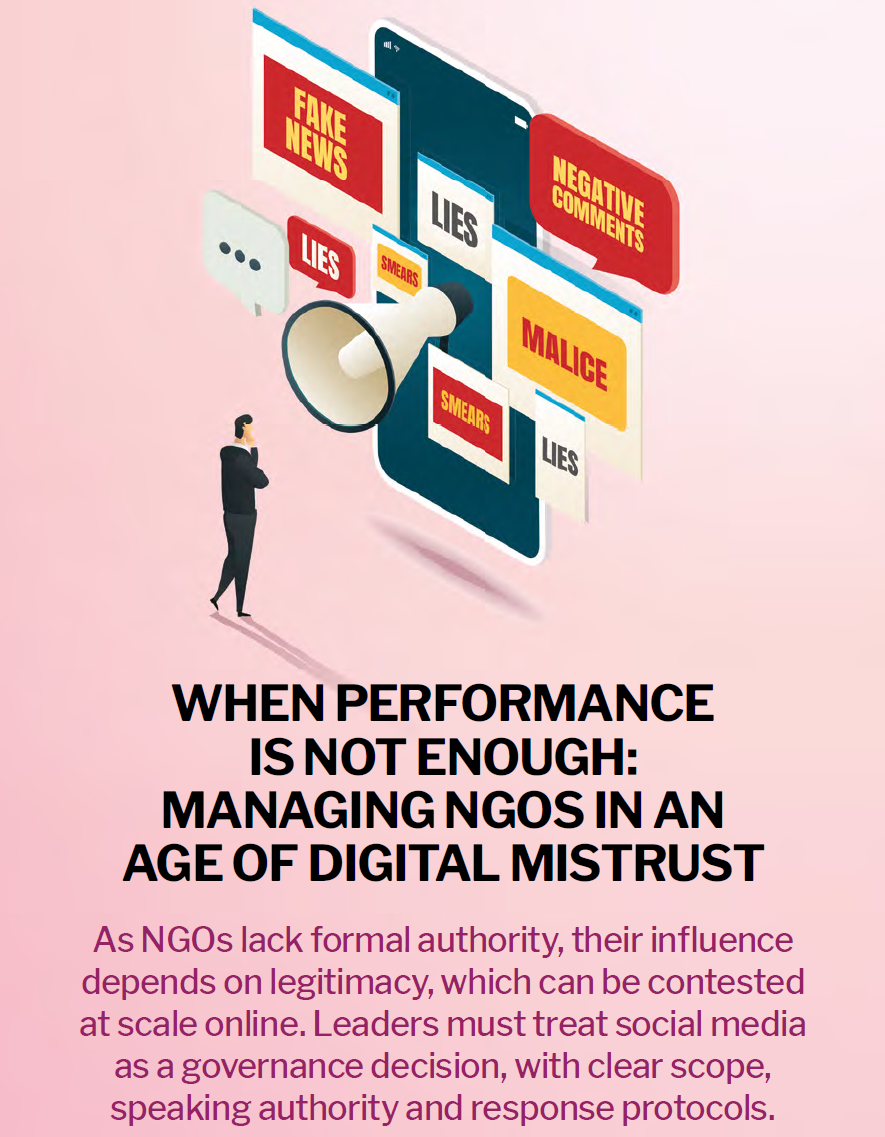
As NGOs lack formal authority, their influence depends on legitimacy, which can be contested at scale online. Leaders must treat social media as a governance decision, with clear scope, speaking authority and response protocols.
1. Perceptions of non-governmental organisations (NGOs) in digital environments increasingly shape their legitimacy and trust more than on-the-ground performance. 2. Although critical for NGOs to engage in online discourse, doing so risks exposure to controversy and mission drift, while avoiding engagement relinquishes narrative control. 3. Organisations should establish clear protocols for engaging with social media, ensuring consistent messaging and alignment with mission objectives. |
Non-governmental organisations (NGOs) play a visible role in service provision for vulnerable communities, charity donation collection, management of community funds and the protection of environmental resources. The third sector is not simply a domain of charity; it is a consequential actor in resource allocation, community welfare and broader social outcomes.
Yet organisational leaders increasingly face a disconnect between what their organisations do on the ground and how they are perceived in public. A health organisation may deliver effective services while facing online accusations of foreign influence. An environmental group may work closely with local communities but become the target of digital campaigns questioning its motives. In online environments, reputations can shift quickly, often independently of performance.
Historically, NGOs have benefited from a presumption of goodwill: they are often viewed with a “warm glow”1 and framed as “principled actors” who work across borders to help diverse populations.2 Today, however, their influence depends not only on what they do and the lives they touch, but also on how they are perceived in digital spaces—particularly on social media and within the wider ecosystems of commentary and amplification that form around them.
For organisational leaders, both in NGOs and beyond, this is not an abstract communications challenge; it is a governance problem. How should organisations manage public narratives that are shaped by social media and, increasingly, misinformation? How much does online contestation matter if programmes continue to function effectively? And at what point does reputational damage translate into real effects on funding or access to policy spaces?
UNDERSTANDING LEGITIMACY
NGO performance is now mediated by digital perception: legitimacy can be challenged online regardless of results, so leaders must treat digital engagement and technology choices as governance decisions central to mission delivery. The practical questions are therefore: how should organisations manage narratives shaped by social media and misinformation, and when does reputational damage begin to constrain funding, partnerships or access to policy spaces?
For NGOs, legitimacy refers to their perceived right to operate and to participate in public decision making.3 It underpins their ability to advocate, deliver services and participate in policy arenas. Unlike governments, which draw authority from elections, or firms, which rely on market performance, NGOs lack formal sources of authority. Their influence depends on whether they are seen as appropriate, credible and aligned with the values they claim to represent.4
This may sound a lot like trust, but the concepts are distinct. Trust concerns expectations about behaviour. It is often interpersonal or relational, built through repeated interactions and perceptions of integrity. Legitimacy, by contrast, is broader and more structural. For NGO leaders, legitimacy determines whether they are even allowed into the conversation; trust determines whether people believe them once they are there.
When legitimacy is questioned, trust becomes weaker. For NGOs, maintaining both requires not only effective performance, but careful management of how actions and intentions are perceived in public. For example, in environmental policy settings, NGO advocacy tends to matter most when civil society actors are widely accepted as legitimate participants in policy debates.5 This legitimacy matters because NGOs lack formal authority: their impact depends on continued access to decision makers, partnerships and public acceptance.
Digital environments have fundamentally changed how the public assess legitimacy. Citizens increasingly encounter NGO work through social media feeds, AI-generated summaries and third-party commentary rather than direct organisational channels. Trust becomes shaped by perception as much as by performance.6 Even where outcomes are strong and donor support remains stable, limited or uneven online visibility can create space for misleading narratives to circulate unchecked. The consequences can be immediate—and dire. Oxfam provides a stark example. Despite decades of humanitarian work, the organisation faced an existential crisis in 2018 when reports emerged of sexual misconduct by staff members in Haiti. Donations plummeted, government funding was threatened and celebrity ambassadors resigned.7
The episode also revealed a broader problem for NGOs: reputations often benefit from a presumption of virtue, which can reduce scrutiny relative to for-profit actors. When that presumption is disrupted, legitimacy shocks can cascade quickly, especially in digital environments where negative information circulates faster than organisational clarification or institutional accountability processes.
TRUST AND LEGITIMACY IN LOWINFORMATION SETTINGS
Publics often assess NGOs in low-information environments. Few people read annual reports or track project outcomes systematically. Instead, evaluations are shaped by simple and visible cues such as who funds the organisation, how it appears in news coverage and what circulates on social media platforms.8 For most citizens, it is far easier to recall the branding of an organisation like the World Wide Fund for Nature (WWF) and its iconic panda than to investigate its activities or financial disclosures.
Social media can intensify these dynamics. Exposure to social media appears to reshape how people evaluate institutions, often reducing confidence in governments while increasing perceived credibility of civil society organisations.9 If so, legitimacy is being redistributed: attention and confidence may be shifting away from formal governance actors and towards NGOs and other civil society organisations.
This advantage, however, is fickle. Research on nonprofit legitimacy shows that legitimacy is inherently fragile, continuously challenged by internal vulnerabilities and external pressures.10 Structural factors such as weak roots and political restrictions can also undermine NGO legitimacy, especially when information is incomplete or contested.11 High visibility may therefore be double-edged: it can confer legitimacy, but it can also amplify doubt, accelerate misinformation, and heighten reputational risk. In low information settings, the same platforms that promote NGOs can just as quickly expose them to suspicion and reputational risk.
HOW SOCIAL MEDIA CAN CHANGE LEGITIMACY AND TRUST
Social media alters how legitimacy and trust are built—and how they are eroded. In digital environments, legitimacy is shaped by online narratives and, at times, misinformation. This poses risks for organisations that rely on trust rather than formal authority, such as legal mandates or official government partnerships. Claims about funding sources, political alignment or alleged hidden agendas can circulate rapidly, while verifying or correcting them requires time and attention that most audiences do not invest. Even when allegations are inaccurate, false narratives often persist.
Public health NGOs offer a clear illustration of how indirect association can undermine legitimacy. During the search for Osama bin Laden, a fake vaccination campaign was reportedly used as cover for intelligence gathering.12 Although humanitarian organisations were not responsible for the operation, the reputational consequences were severe. In parts of Pakistan and Afghanistan, vaccination workers became associated with foreign surveillance and political interference. Polio vaccination rates declined, and health workers faced harassment and violence.13 Trust that had taken decades to build was weakened not by organisational failure, but by suspicion and rumour, showing how misinformation can damage legitimacy even when NGOs are not directly implicated.
Environmental debates show how social media can distort public discourse and legitimacy. Research on environmental communication demonstrates how social media platforms can amplify misleading or polarising narratives about climate and environmental issues.14 Other studies of climate change misinformation find that false or misleading content about environmental issues circulates widely on social media, reinforcing polarised views and reducing trust in expert voices.15 Strategic disinformation campaigns have also used social media to sow doubt about environmental science and policy, portraying environmental action by NGOs as economically damaging or ideologically driven.16 As these narratives gain traction, they shape who is treated as a legitimate participant in public debate and which arguments are considered acceptable.17
For NGO leaders, this creates a strategic dilemma. Engaging directly on platform terms risks oversimplifying complex issues and drawing organisations into polarised exchanges. Avoiding engagement, however, risks ceding narrative control entirely.18 Over time, these pressures can deeply affect organisational behaviour and contribute to mission drift.19 Staff time is diverted toward reputational defence rather than programmatic work, and public communication becomes reactive and cautious rather than mission driven.
Research on non-profit social media use suggests that many organisations respond by limiting engagement. Social media is treated primarily as a broadcast tool focused on image management rather than dialogue.20 While this approach may reduce immediate exposure to controversy, it can also constrain how NGOs build sustained relationships and legitimacy with the publics they serve.
WHEN TECHNOLOGY INTRODUCES NEW RISKS
New technologies can also affect legitimacy and trust in ways that organisations do not always anticipate. In 2023, Amnesty International faced significant backlash after publishing AI-generated images on social media to depict human rights abuses during protests in Colombia.21 The stated intention was to protect the identities of protesters while drawing attention to violations. The response was swift and critical. Journalists, photographers and activists argued that the use of synthetic imagery blurred the boundary between documentation and fabrication in a context where evidentiary credibility is important. Amnesty International later removed the images.
This episode highlights a broader challenge for advocacy organisations. Legitimacy rests on claims to accuracy, authenticity and moral authority. Even when new tools are used transparently and with ethical intent, they can undermine trust if audiences perceive a departure from established norms. Social media can intensify this risk by encouraging rapid judgment and binary reactions rather than deliberation.
As AI tools become more accessible, organisations face new trade-offs between visibility and credibility. Technologies that promise efficiency can also introduce doubt about authenticity and intent. For NGO leaders, managing legitimacy increasingly requires anticipating not only what technologies can do, but how their use will be interpreted by sceptical publics.
WHAT GOOD SOCIAL MEDIA MANAGEMENT LOOKS LIKE
Some NGOs have developed social media practices that reinforce legitimacy and trust. The emphasis is less on constant reputation management but more on purpose-driven use of social media supported by clear internal rules and governance. Doctors Without Borders (MSF) demonstrates this measured approach well. Their content prioritises field-based updates from medical staff, maintains consistent institutional voice across platforms and uses real-time reporting during humanitarian emergencies. MSF’s social media strategies emphasise eyewitness accounts and visual documentation from operational zones,22 reinforcing their authority on medical crises without resorting to sensationalism.
Save the Children has adapted to social media by shifting to completely digital campaigns before releasing their mission to traditional media. The organisation works selectively with influencers aligned with their mission, uses real-time field reporting during crises and coordinates messaging across platforms to maintain narrative coherence.23 Their approach recognises that digital audiences often encounter content through shares and recommendations rather than direct follows.
A regional example comes from WALHI, the Indonesian Forum for the Environment. WALHI maintains an active presence on multiple platforms and has used social media effectively to document environmental violations and coordinate with local communities. During conflicts over palm oil development, WALHI used field documentation with a step-based advocacy process that moves from fact-finding to planning, to action and to evaluation. Their documentation of each step helps local issues travel credibly to a national and international audience.24
Across these cases, governance is important. Senior leadership sets boundaries, approves tone and defines acceptable risk. Social media teams are not left to manage crises in isolation. These organisations treat digital strategy as part of organisational mission, not a peripheral communications function.
IMPLICATIONS FOR LEADERS
For organisational leaders, the central implication is that legitimacy and trust cannot be left to chance. Digital engagement requires governance: leaders need to establish clear protocols for how the organisation communicates online, who speaks on its behalf and where boundaries lie. Social media practices should reinforce the mission rather than chase attention. Trends and viral formats can be tempting, but when they dilute purpose or blur organisational voice, the reputational costs can outweigh short-term reach.
Leaders must also recognise that technology can introduce reputational risk. New tools are often adopted for practical reasons, but their use can reduce legitimacy if audiences interpret them as departures from established norms. Decisions about adopting digital or AI tools are therefore not merely technical choices; they are judgments about how the organisation wishes to be perceived and trusted. While the everyday use of AI in internal management may be relatively low risk, the explicit use of AI in public communications, imagery or advocacy demands higher scrutiny and greater caution.
Finally, digital strategy must be contextual. Practices that work in one sector or political environment may fail in another. Organisations operating in politically constrained settings face different risks than those working in more open contexts. Social media dynamics vary across countries, languages and issue areas. Strategies that travel poorly can unintentionally expose organisations to backlash or misinterpretation.
GUIDANCE FOR ORGANISATIONS STARTING THEIR DIGITAL JOURNEY
For small NGOs or those just beginning to build a social media presence, the primary challenge is deciding whether and how to engage at all. Social media is not mandatory. Many organisations operate effectively through direct relationships with communities and traditional print media. A decision to establish a social media presence should follow from mission needs and strategic goals, not from the assumption that visibility automatically creates influence.
When organisations do choose to engage with social media, starting narrowly is often more effective than spreading efforts thinly. Focusing on a single platform that works well with the organisation’s primary audience reduces the risk of inconsistent messaging or social media abandonment. A reliable presence on a single channel typically builds more credibility than a fragmented presence across several.
Rules governance matters even more in smaller organisations. Limited capacity can make NGOs vulnerable to mission drift driven by online pressure. Leaders should decide in advance which topics fall within scope, who has authority to post and how criticism or misinformation will be handled. These decisions are far more difficult to make during a public dispute.
In resource-constrained organisations, documentation often matters more than entertainment. Treating social media as a record of ongoing work rather than a marketing tool can build legitimacy over time. Simple updates, photographs from the field and clear reporting of milestones are often sufficient. In these circumstances, high production value is less important than consistency and clarity in communication.
Relationships can also compensate for limited online followings. Creating or maintaining connections with journalists, researchers and local communities are often more valuable than social media reach alone. NGOs are already embedded in networks through their work on the ground; extending these relationships into online spaces through dialogue can increase organisational voice. Credible local sources are in demand, and trusted relationships often amplify messages more effectively than platform metrics.
Looking ahead, social media is likely to become more demanding. As AI-generated content becomes more widespread, the volume of misinformation circulating online will increase, making it harder for organisations to control how their work is represented. Small organisations cannot respond to every claim or trend. The central challenge, therefore, is focus; leaders must keep attention on mission objectives while navigating a crowded information environment so they can continue doing the work that matters.
Christianna Sirindah Parr
is an Assistant Professor of Political Science and Public Policy at Singapore Management University. She received her PhD from the University of Washington. Her research examines environmental governance, civil society and legitimacy in Southeast Asia. Her work has appeared in the Journal of Public Policy and Global Policy, and her commentary has been featured in The Washington Post.
For a list of references to this article, please click here.