

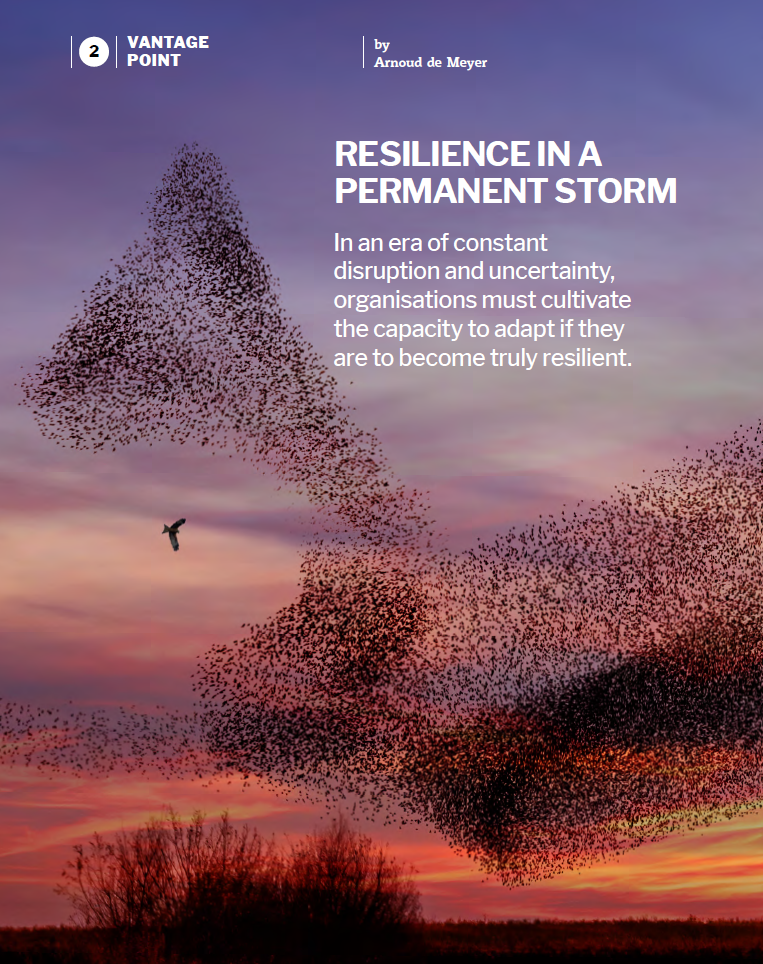
In an era of constant disruption and uncertainty, organisations must cultivate the capacity to adapt if they are to become truly resilient.
1. Resilience once meant withstanding pressure and restoring operations after disruption. Today, it increasingly depends on an organisation’s capacity to adapt in a highly volatile environment. 2. In the relentless pursuit of optimisation, organisations risk 3. Leaders must move from shaping decisions to shaping |
For much of the past fifty years, corporate stewardship proceeded under a largely unwritten, deeply comforting set of assumptions: while acute disruptions—a sudden currency crash, a cyber-attack, a regional conflict—would inevitably punctuate the business cycle, stability remained the baseline condition. Beneath these disturbances lay a powerful implicit belief that stability would eventually return after the disruption: economic cycles would normalise, markets would settle, institutions would regain their balance and globalisation would continue to dominate. Disruption was temporary; equilibrium was permanent. The goal of management was to ride out the turbulence and safely steer the ship back into the calm waters of the known status quo.
Today, that foundational assumption has collapsed.
The modern corporate landscape is no longer experiencing temporary, isolated disturbances around a stable equilibrium. Instead, those disturbances have combined, intensified and accelerated to form the environment itself. The forces driving this shift are structural, interconnected and irreversible:
- Geopolitical Fragmentation: The smooth, flat world promised at the end of the Cold War has fractured into defensive economic blocs, proxy conflicts and regulatory balkanisation.
- Technological Acceleration and Disconnection: Generative and agentic artificial intelligence and automation are altering the shelf-life of products, skills required and business models at such a pace that initial capital expenditures can barely be depreciated. Additionally, we see a growing divergence and competition between the coalitions around the US and China, leading to incompatibility.
- Environmental Pressures: Climate disruption is moving from a line-item in corporate social responsibility reports to a real and visceral liability affecting physical assets, insurance premium viability and real-time resource availability.
- Demographic Transitions: Ageing workforces in virtually all developed economies, particularly in East Asia, alongside shifting labour expectations are fundamentally rewiring talent pools and consumer markets.
For generations, management education and corporate leadership were built around a specific toolkit: prediction, long-range planning, hyper-optimisation and centralised control. The dominant managerial ideal was efficiency: gathering sufficient information to forecast the future accurately and allocate resources with maximum precision. Strategic planning assumed that uncertainty could largely be reduced to calculable risk. Organisations were designed to minimise variation, standardise operations and eliminate redundancy.
Yet leaders today increasingly confront uncertainties that cannot be modelled with confidence. Nassim Nicholas Taleb famously described such events as “Black Swans”—rare, high-impact occurrences that become explainable only in retrospect. But contemporary business conditions suggest something even more challenging: uncertainty itself has become structural rather than exceptional. Organisations should no longer be preparing for occasional disruptions, for they are operating within a permanently unstable system.
Calculable risk can be managed with an insurance policy or a hedged derivative; it belongs to a universe where the probabilities of future outcomes are known. But true uncertainty, or “unknown unknowns” as I have described elsewhere, defies computation. When the variables themselves are constantly mutating, the traditional playbook of prediction and control becomes worse than useless—it may become a source of systemic vulnerability.
To survive, institutions must abandon the illusion of permanence and consciously construct a different asset class: organisational resilience.
REDEFINING RESILIENCE
The classical understanding of resilience emerged largely from engineering and systems theory. A resilient bridge, machine or infrastructure system could absorb stress and return to its original state. Much corporate thinking still reflects this logic: the
resilient company is one that survives disruption and restores normal operations quickly. It is not unlike an elastic band—stretched by a crisis but possessing the tensile strength to snap back to its original shape.
Yet, the defining feature of contemporary uncertainty is that the original shape may no longer be viable. The ground beneath the organisation has shifted so fundamentally that returning to the old equilibrium may well be a recipe for irrelevance or obsolescence. True resilience is not a defensive crouch; it is a dynamic capacity.
The old definition of resilience was about robustness; the modern definition is about adaptiveness. Truly resilient institutions are not those that successfully resist change, but those capable of continuous internal rearrangement without losing their core coherence or overarching sense of purpose.
This distinction transforms resilience from a reactive crisis management function into an active, everyday operational stance.
For a corporation, non-profit organisation or public agency, this means developing the capacity to pivot strategies, reallocate capital and redesign workflows in real time. The goal is to achieve a state of fluid continuity: preserving the institutional identity and the “why” of the enterprise, while remaining utterly unsentimental about the “how”.
DESIGNING THE ADAPTIVE ORGANISATION
If the traditional organisation is a machine designed for a specific factory floor, the adaptive organisation is a living network designed to navigate a shifting jungle. What do these adaptive structures do differently? To observe them in practice is to witness a departure from standard twentieth-century management orthodoxies.
Distributed Intelligence and Decentralised Action
In a highly volatile environment, information quickly becomes stale as it travels up a steep corporate hierarchy, and instructions are frequently obsolete by the time they filter back down to the front lines. Adaptive organisations solve this by decoupling decision-making from formal hierarchy, distributing intelligence to the periphery where the organisation directly interacts with reality.
This decentralised philosophy is guided by a powerful, unyielding central ethos. Frontline teams do not operate in a vacuum; they are bound by a shared strategic intent and a clear set of core principles. This allows for what is known in the military as “mission command”, executing localised, highly autonomous actions that align with the broader corporate goal without requiring explicit permission for every tactical adjustment.
This model can become essential whenever a central command structure risks being cut off, jammed, or simply too slow to keep pace with fast-moving, on-the-ground conditions. Autonomous units are bound not by a real-time communications loop, but by a shared understanding of intent. If the centre goes dark, they know exactly what the mission is and how to execute it within their local context. In the corporate arena, this translates to empowering local country managers, frontline engineers or product teams to make definitive calls based on immediate data, secure in the knowledge that they are operating within a well-understood institutional framework.
Promoting Institutional Memory
In a world characterised by high employee turnover and rapid strategic shifts, organisations frequently suffer from collective amnesia. They make the same mistakes every few quarters because the lessons of past crises were tied to individual people rather than embedded in the organisational architecture. Experience is sometimes treated as a liability rather than an asset, yet organisations that lose historical memory often lose contextual judgement as well.
During the 2008 global financial crisis, many institutions rediscovered risks that previous generations of bankers had understood well, but which had gradually faded from organisational memory. The same pattern emerged during the COVID-19 pandemic: many governments and companies alike lacked the institutional knowledge required to manage largescale systemic disruptions, because decades of relative stability had eroded preparedness.
Adaptive enterprises treat institutional memory as a living asset. They build systematic mechanisms—rigorous post-mortems, accessible knowledge repositories and cross-generational mentoring structures—to ensure that hard-won operational insights are codified and distributed. Every disruption is treated not just as a cost, but as a paid education—one they are committed to learning from.
Leadership Humility
The myth of the all-knowing executive who diagnoses every problem from a top floor corner office is dead. In an era of intense technological and systemic complexity, adaptive organisations require leaders who possess the humility to acknowledge what they do not know.
Humility at the top creates psychological safety throughout the organisation. When leaders admit uncertainty, it signals to the rest of the enterprise that it is safe to report unpleasant truths, surface hidden risks and challenge legacy assumptions before they turn into catastrophic failures.
Constant Experimentation and Rapid Learning
Instead of betting the entire company's future on a single, massive five-year plan, adaptive organisations operate via a portfolio of small, controlled experiments. They launch minimum viable products, test new supply routes and pilot alternative workflows in isolated markets.
The goal is to fail cheaply and learn quickly. By lowering the cost of experimentation, they turn learning into a continuous, low-risk habit rather than a high-stakes gamble. Organisations must also develop the ability to distribute the positive learnings quickly throughout the enterprise.
Constructing business ecosystems to share risks and assets
Resilience also requires diversity. Homogeneous systems optimise easily but adapt poorly. Diverse supply chains, diverse leadership perspectives and diverse organisational capabilities provide flexibility under changing conditions. Ecologists have long understood that ecosystems with greater diversity tend to display higher resilience. Organisations increasingly face similar realities. In the book Ecosystem Edge: Sustaining competitiveness in the face of disruption, my co-author, P.J. Williamson, and I argued that competitive strength will be based on companies’ capability to develop business ecosystems that can combine their assets and competencies to produce value for the ultimate customer. Business ecosystems provide organisations with the flexibility to scale up when opportunities arise and have enabled a number of Chinese technology-based firms in retail, finance and electric vehicle assembly to scale rapidly.
THE PERILS OF PERFECT OPTIMISATION
For the past three decades, corporate boardrooms were wholly committed to the pursuit of efficiency—a pursuit which I, too, am guilty of teaching in my operations management classes on lean operations. Guided by the tenets of Six Sigma, lean manufacturing, just-in-time inventory management and aggressive financialisation, executives stripped every ounce of “waste” from their systems. Warehouses were replaced by real-time logistics streams, redundant factories shuttered or consolidated, and supply chains stretched across continents to capture the lowest possible labour costs, with components crossing multiple borders before final assembly.
This system functioned remarkably well—until it didn’t.
On paper, during periods of geopolitical calm and predictable economic growth, this optimisation was a financial masterstroke. It lowered overhead, maximised short-term return on capital, boosted quarterly margins and delighted Wall Street.
But it did something else that went largely unnoticed: it systematically stripped away the structural dampeners that protect a system from shock. It turned resilient, flexible networks into brittle glass.
The pursuit of hyper-efficiency operates on the flawed assumption that the future will behave exactly like the immediate past. When you eliminate all excess capacity, you are betting everything on perfect operational continuity. If a single link in that highly optimised, hyperconnected chain fails, the entire system grinds to a halt.
The financialisation of the corporate world further compounded this vulnerability. Cash reserves were deployed for share buybacks rather than balance sheet strength; capital expenditure was squeezed to present a leaner profile to investors. The result was a corporate ecosystem filled with elite athletes possessing zero body fat—exquisitely tuned for a smooth indoor track, but entirely incapable of surviving a night in the jungle.
REINTRODUCING THE ARCHITECTURE OF SURVIVAL
The early 2020s delivered a brutal, systemic lesson in the dangers of over-optimisation. The cascading disruptions of the COVID-19 pandemic revealed that global supply networks were so tightly coupled that a factory shutdown in one Chinese province or labour shortage in a Chinese port could freeze automotive assembly lines in Europe for weeks.
Subsequent geopolitical flashpoints have hammered home this reality. The recurring instability surrounding chokepoints such as the Strait of Hormuz, and the weaponisation of critical shipping lanes more broadly, have demonstrated that geography still matters. Physical vulnerabilities cannot be fully engineered away by digital dashboards. These realisations have forced a slow, painful reappraisal of institutional design. True resilience requires the deliberate, often expensive reintroduction of architectural features that the previous generation of managers spent their careers eliminating:
- Redundancy: Having a single, low-cost supplier for a vital component is efficient; having three suppliers across different geographies is resilient. Keeping inventory close to the end consumer may incur additional costs, but it prevents stockouts when shipping lanes are disrupted. Redundancy is the insurance premium an organisation pays to improve its chances of survival.
- Diversity: Resilient systems do not rely on a single piece of technology, a single market or a uniform profile of thinking. They cultivate diverse revenue streams, energy inputs and cognitive perspectives within leadership teams to ensure they are not blinded by collective groupthink when a novel crisis emerges.
- Decentralisation: By breaking monolithic corporate structures into smaller, modular units, organisations can contain and minimise damage. If one division or regional hub is compromised by a cyberattack or geopolitical crisis, the remaining units can isolate the infection and continue operating, preventing total system failure.
- Time for Reflection: In an always-on, hyperconnected business environment, executives are caught in a relentless cycle of reactive firefighting. They jump from one urgent WhatsApp message to the next, with no cognitive bandwidth left to analyse structural trends or anticipate incoming disruptions. Adaptive organisations dedicate time for strategic reflection, treating deep thought not as an idle luxury but as a critical risk-mitigation discipline. Organisations unable to pause, reassess assumptions and reconsider strategic direction gradually lose the ability to evolve intelligently.
The shift may be described as one from “just-in-time” to “just-in-case”: the organisations that thrive in the next era may not be the most optimised, but the most adaptable.
THE INSTITUTIONAL SCAFFOLD
Organisations do not exist in a vacuum. A corporation cannot be truly resilient if the society surrounding it is fracturing, and an enterprise cannot plan if the broader legal and regulatory environment is unstable.
The resilience of individual organisations ultimately depends on the strength of the background architecture—the social institutions that provide continuity, trust and legitimacy.
When public institutions, regulatory agencies and legal frameworks function effectively, they provide a reliable foundation of predictability. They ensure that contracts are enforced, infrastructure is maintained and public data remains trustworthy. This institutional stability creates social capital—the invisible glue of trust that allows businesses to transact, invest and cooperate during periods of intense market stress.
When that background framework degrades—whether through political polarisation, systemic corruption or institutional drift—the cost of doing business rises exponentially. Organisations are forced to spend enormous amounts of energy building their own private security, verification and compliance mechanisms. In a time of pervasive uncertainty, preserving the health, integrity and legitimacy of these foundational public institutions is not a soft, altruistic endeavour. It is a hardheaded economic necessity for any organisation that hopes to survive over a multidecade horizon.
THE NEW MECHANICS OF LEADERSHIP
As the environment mutates, the nature of corporate command must change with it. Modern organisations operate in systems so technologically, logistically and institutionally complex that the traditional model of the lonely CEO at the top is obsolete. No single individual, no matter how brilliant or energetic, can genuinely comprehend the entirety of a global corporate system or predict the interactions of its moving parts.
The implication is clear: leadership must shift toward a more sophisticated, distributed art.
The modern leader's role is not to dictate every move, but to design and steward the ecosystem. In other words, the leader shapes not the decisions, but the context in which they are made. This demands three specific capabilities:
- Interpretation: The leader acts as an institutional translator, filtering through the noise of a chaotic world to identify the signals that genuinely matter. They help the organisation make sense of its environment, contextualising sudden disruptions so the workforce can react with focus rather than panic.
- Orchestration: Instead of managing line items, effective leaders manage interfaces. They connect disparate parts of the enterprise, break down internal silos and ensure that information, resources and talent can flow rapidly to where they are needed most.
- Trust-Building and Collective Intelligence: The ultimate task of the modern executive is to build a high-trust culture that unlocks the collective intelligence of the entire workforce. They create an environment where insights are shared freely, where frontline workers feel safe making autonomous decisions, and where the organisation's collective capacity to learn moves faster than the external environment's capacity to disrupt.
The era of management as an exercise in elegant engineering is over. The leaders who succeed in this uncharted territory will not be those who build the most rigid, optimised fortresses, but those who learn to conduct a living, evolving orchestra amid the noise of a permanent storm.
Arnoud de Meyer
is Professor Emeritus at the Lee Kong Chian School of Business at Singapore Management University and Independent Director of several commercial and non-profit institutions.