

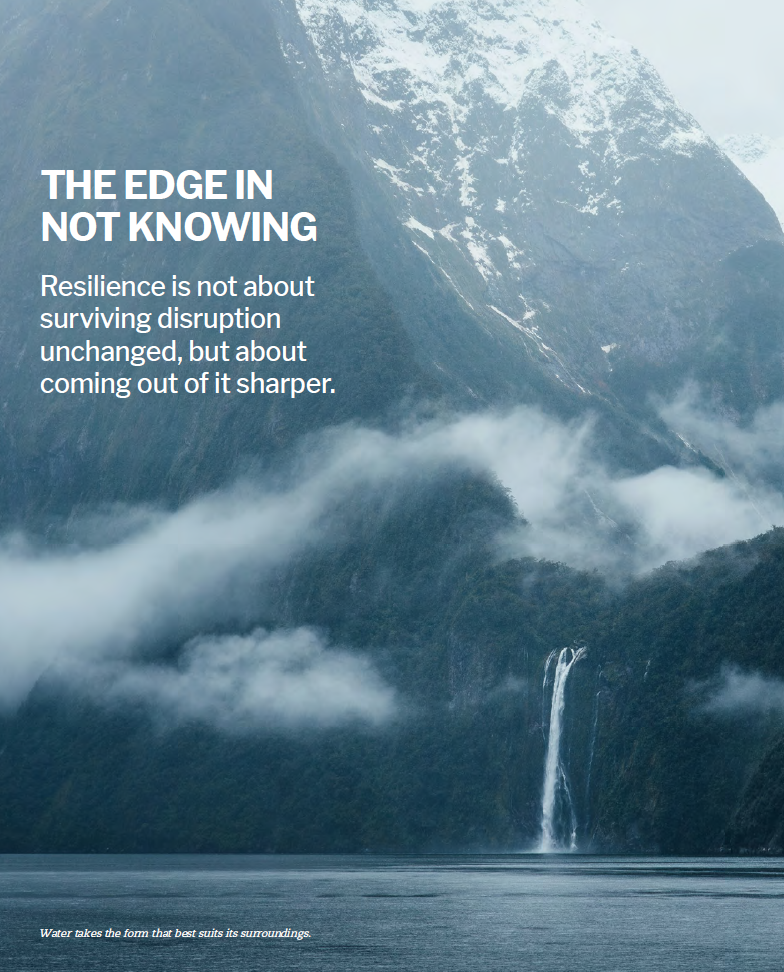
Resilience is not about surviving disruption unchanged, but about coming out of it sharper.
1. Resilience encompasses more than robustness or recovery; organisations need to distinguish between withstanding disruption, adapting to it, and, in some cases, improving through it. 2. Survival intelligence combines three capabilities: learning and unlearning, contextual fit and strategic optionality. 3. Leaders should rely less on precise forecasts, rather design systems that can revise assumptions, absorb error and change course. |
Imagine you are late for a flight, and you tell the driver to take the shortest route to the airport. He does exactly that, but the route turns out jammed with traffic and red lights, so you crawl to the airport and miss the plane. The driver did his job. The route really was the shortest. You simply asked for the wrong thing: you wanted the fastest way there, and you asked for the shortest. The same logic plays out every time governments, boards and management teams ask for "resilient" systems: they get precisely what they asked for and then wonder why it is not what they wanted.
WHAT RESILIENCE IS NOT
When systems try to predict the unknowable, we get rigidity, not resilience. When something unforeseen arrives, the rigid system breaks like brittle glass. The pandemic exposed how brittle “just-in-time” supply chains were under disruption, pushing many firms towards “just-in-case”.1 Even robust systems turn brittle in conditions they were not built for. Nokia serves as a literal case in point: its dominance rested in part on its famously indestructible hardware. But when the iPhone arrived, that toughness mattered less than the software ecosystem around it, and its market value soon collapsed.2 The robustness was real, but not contextually relevant. The shift we need is from assuming controllability to accepting fallibility: from "we know the future and can control it" to "we do not know it and can still thrive in it".
When you dig into the etymology of grit and robustness, you will find that, beneath the motivational sheen, lies hardness and firmness: the assumption that if you are strong enough, nothing will break you. It is an egotistical position, one that presumes you can predict and control what is coming. Perhaps what we want is not robustness, but agility, flexibility, adaptability. Yet even agility is built around adapting to change, and that quietly assumes we will see the change in time to adapt to it.
ARTICULATING WHAT WE WANT IN RESILIENCE
So, what do leaders and organisations want when they ask for resilience? The underlying desire seems not merely to survive shocks, but to benefit from disruption in some way; rather than simply passing through a storm unscathed, we want to emerge from it better than before.
Think of the stories we tell about resilient people. The protagonist faces hardship and succeeds. But notice what we are actually celebrating: not someone who remained unchanged amid adversity, but someone who came out of it stronger. Not robust, but “antifragile”.3
Call this capability Survival Intelligence. Not survival as toughness or endurance, and not romanticisation of chaos or disruption. Survival in the sense of thriving: the capability of understanding and harnessing antifragility, of benefitting from the unforeseeable by counterintuitively accepting the unknowability and building around it. Intelligence, after all, also means knowing where your knowledge ends.
Survival Intelligence operates at more than one level simultaneously, because the levels constantly shape one another. What societies normalise, organisations replicate. What organisations expect, individuals internalise. And what individuals practise eventually loops back to reshape the organisations and societies they belong to. The loop runs in both directions, which is why a sincere conversation about resilience cannot happen at any one level alone. Leaders are at the confluence of these levels. Their job is not to perform certainty, but to build conditions in which Survival Intelligence can take hold.
Survival Intelligence rests on three properties. The first is the capacity to learn and unlearn, to update one's map as the territory changes. The second is contextual fit, the alignment between a system and the environment in which it has to work. The third is hedging, keeping enough alternatives to avoid being trapped by a future you cannot foresee.
LEARNING IS THE NEW FLEX
Imagine driving down a fog-covered road at night. Control here does not come from making a brave prediction that nothing will appear in your way. It comes from realising that going slow enough will allow you to see and leave room to react. In an uncertain world, learning and unlearning are the organisational version of that behaviour.
Learning in this sense is not the same as training. Training assumes you know enough about what lies ahead to prepare in advance. Learning, on the other hand, is the discipline of observing what is actually happening and revising assumptions as new information appears. Going slowly enough to observe is learning, and it is the prerequisite for driving through the fog.
Aluminium was once rarer than gold: royalty served their most prized guests on aluminium while everyone else made do with gold plates. Then, chemists worked out how to extract it cheaply, and it moved from royal tables to kitchen foil. Yet mining companies continue to profit substantially from aluminium by processing it into more useful products. Knowledge is now having its aluminium moment. Large language models can retrieve and remix information at a speed no human can match, and raw knowledge is becoming cheaper by the day. Its value is shifting the same way it did for aluminium: from possessing the raw material to processing it, framing the right questions, synthesising across domains, connecting and contextualising what is now cheaply available. Survival Intelligence, in this context, is noticing the shift while it is still unfolding, rather than training everyone around a snapshot of today's tools.
At the individual level, this is the willingness to unlearn. Take George, who, for the past few years, worked relentlessly to build his skills and advance within his organisation, enduring hardship after hardship until it left him depleted. Instead of powering on, however, he did what the old script of resilience forbids: he stopped. He took a break, reconsidered what he was chasing and came back with different priorities, titles mattering less than paying the bills and being present at home. He had unlearned an outdated definition of success and relearned one that fit his current stage of life. That is genuine resilience, and it is easy to mistake it for weakness because it looks like slowing down. Its opposite looks like strength: powering on, never yielding, pushing through. But a script held rigidly long after it has stopped fitting does not bend. It snaps, and by the time it does, there is no slack left to absorb the fall. What looked resilient turned out to have been brittle after all.
Another related example of (un)learning is unfolding before us. Waves of layoffs and restructurings are forcing people to confront how tightly their sense of self is tied to a job title. Losing work not only removes an income; it removes a piece of who you are.4 The meta-skill of the moment is unlearning the equation of "I am my job", because an identity built entirely on full-time employment is fragile by design.
The same logic extends to organisations. Many "learning" or "agile" organisations are, in practice, training organisations: a new technology appears, and the reflex is to run everyone through a course. That may be useful, but it is still a bet that the skill set being installed will stay relevant. A genuinely learning organisation treats mistakes, near-misses and small failures as information rather than embarrassments to be buried. High-reliability industries such as aviation and nuclear power have long worked this way: an incident is something to study openly, not hide, because the disturbance noticed early is the disaster avoided later.5
Learning, therefore, is not a quarterly workshop. It is built into ways of working, debriefs, near-miss reporting and the habit of listening to the people closest to the work, so that shocks become information rather than a final exam.
DESIGNING FOR CONTEXT
There is a Hindi proverb that captures contextual fit well: what a needle can do, a sword cannot. A sword may be more impressive, but it is useless when the task is to stitch torn fabric. The question is not whether a tool is strong in the abstract, but what it is strong for.
Take how we talk about strengths, as though it were a fixed possession you carry intact from one situation to the next. In a negotiation workshop I run for senior professionals, I ask participants to name one strength and one weakness they bring to difficult conversations. What unsettles the room is how often the same trait appears as a strength on one person's list and a weakness on another's. Being highly direct is, for one participant, what cuts through noise; for another, it has cost them a key relationship. Move between cultures and the sorting flips again: the talkative warmth that builds trust in one place can read as insincere in another. The trait is neither. What makes it an asset or a liability is the context in which it lands.
Survival Intelligence is the ability to notice which of your competencies are genuinely portable and which only looked impressive because the old environment was especially favourable to them: compatibility, not dominance, is what Darwin’s ‘survival of the fittest’ was always about. It is why many competent individuals struggle to find their footing amid disruption. Often nothing is broken; the context has merely changed, and the old tools no longer fit it.
At the organisational level, this involves employing strategies appropriate to the environment in which it operates. What works elsewhere may still be useful, but ‘best practice’ is only the starting hypothesis until it has been tested against context. When IKEA faced child-labour allegations in its carpet supply chain in India, the decisive-looking moves were to cut off suppliers or mandate blanket certification.6, 7 Either would have protected the brand while doing little about the actual conditions, and some would have exacerbated the situation, cutting off family incomes and displacing the very children in question. Instead, IKEA studied the context and found it was more nuanced than it first appeared: some children were trapped in bonded labour to pay off family debts, but others were learning a craft alongside their parents, work the local law itself protected, and many were on shop floors likely because there was no childcare.8 So rather than cut ties, IKEA addressed the cause instead of the symptom by funding schooling and childcare near its suppliers. The result was not just continued sourcing—the narrow, robust win—but greater trust and materially better lives for those children. That is compatibility: not the solution that looks most decisive, but the one that actually fits the context it is in.
The same logic is visible in the built environment. Glass-and-concrete towers signal progress, but they were designed for cooler climates. In India's tropical heat, they trap warmth and create urban heat islands. This drives up air-conditioning use, which pushes yet more heat outdoors, creating an ever-tightening loop. From a distance the skyline looks world-class. But it is fragile underneath, dependent on cheap energy to stay habitable and exposed to every heatwave and power cut. Traditional climate-responsive features such as courtyards, shading and ventilation were generations-old, locally compatible answers to the same heat. We did not just import buildings; we imported fragility mistaken for sophistication.9
HEDGING AGAINST THE UNKNOWN
The human body contains two kidneys, even though it can survive with one. As Taleb puts it, if an economist designed human bodies, perhaps five people would share a kidney. But the second kidney is not evidence of inefficiency; it is protection against disease or accident. Nature carries redundancy because preparing to survive beats assuming the worst will never happen. In a world you cannot forecast, the rational move is not to commit everything to a single path, but rather to keep a portfolio of options.
At the individual level, it means letting nothing in your life carry all the weight. We know this well from finance: not putting all your savings into a single stock but diversifying your investments. The same logic applies to career, skills and identity. If your sense of self runs entirely through a single role, losing that role takes you with it. The person who is also a parent, a friend, a runner, and a community member has their identity stored in different places. None is sufficient on its own. Together, the collective identity is resilient to being destroyed by any single loss.
At the team level, this same principle separates a plan from a gamble. A hospital with several surgeons trained on a critical procedure has options when one is unavailable; a hospital relying on one surgeon has none. A team run permanently at full capacity has quietly refused all optionality; every hour is already spoken for, so every surprise becomes a crisis. Buffers in project timelines work for the same reason: they create room to absorb surprises and, when the surprise does not come, room to improve the work or gather new information.10
At the organisational level, just-in-time inventory was the efficiency triumph of its time, with its minimal stock and minimal waste. It worked beautifully until the first serious shock in 2020, when firms with no buffer discovered just how exposed they were. “Just-in-case” re-entered the vocabulary as the correction: some stock has to sit on a shelf doing seemingly nothing, against the day it becomes the only thing that matters. The opposite of hedging, at every level, is commitment with no way back. Every choice can be put to one test: does it keep options open, or narrow them? The second kidney looks wasteful only until the day you need it.
THE RESILIENCE WE DESIRE
None of this asks leaders to abandon forecasting. It asks them to stop mistaking forecasts for certainty. Survival Intelligence is what remains once that illusion goes: the capacity to learn and unlearn as the ground shifts, to build what fits the context in front of you and to keep enough options open to change course when your assumptions fail.
The questions that follow are practical ones. What signals are we not yet hearing, and how fast can we revise our assumptions when we do? Which practices have we imported wholesale because they worked elsewhere, without checking whether they fit here? Where have efficiency and full commitment quietly stripped out every margin we would need to absorb a shock? None of these questions abolish uncertainty. They simply stop an organisation from pretending it can.
Not knowing the future is not the worst thing. The worst thing is insisting that we can know and control it. What we need is a calibrated acceptance of not knowing, and the discipline to stay with that discomfort long enough to learn from it, design for compatibility and keep some options open. Survival Intelligence sounds unsexy; it does not make for a good motivational poster. It is, however, what we have been craving all along under the wrong name.
We asked for the shortest route and got exactly that. If we wanted the fastest, we had to say so. And if what we want is resilience, not robustness dressed up in its name, we have to learn to ask for what we actually mean.
Neal Jha
is an expert on sustainable approaches to changing human behaviour in organisations. He researches inclusion and diversity at the National University of Singapore (NUS), and teaches ethics at Singapore Management University (SMU) and organisational behaviour at Nanyang Technological University (NTU). He received his PhD in Organisational Behaviour from SMU and a Bachelor's in Engineering from NTU. Prior to his PhD, he worked in commercial roles in the mining industry. He writes and consults with organisational and individual clients on difficult conversations and leadership, keeping his work grounded in both academic research and real-world impact.
For a list of endnotes to this article, please click here.