

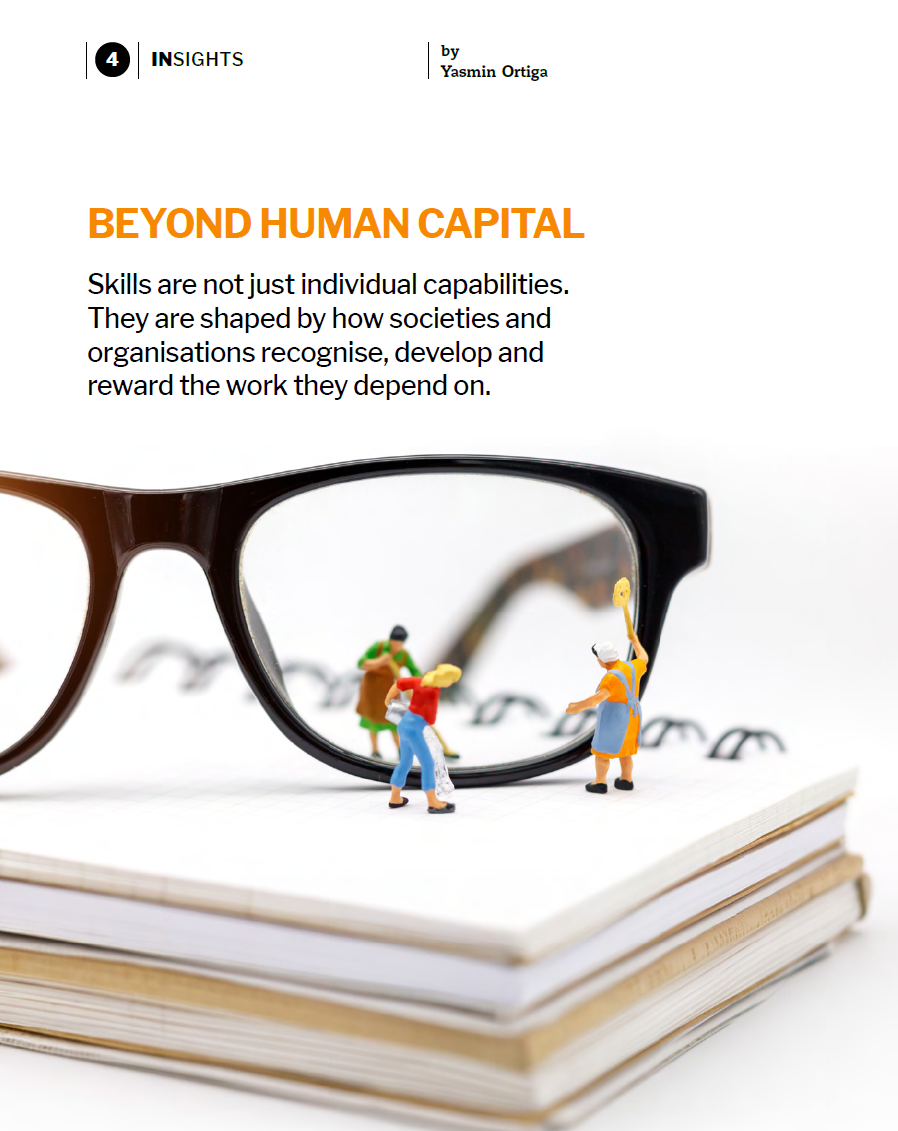
Skills are not just individual capabilities. They are shaped by how societies and organisations recognise, develop and reward the work they depend on.
1. Recognition, not just competence, determines whose skills count. In licensed professions, it can determine whether someone can practise at all. 2. How skills are perceived can have far-reaching consequences, especially in industries where their core functions are not formally recognised as skilled work. 3. Building capabilities for resilience involves approaching skills not as a resource to accumulate, but as capacities to recognise, develop and reward fairly. |
Anxieties about the future often spark efforts to equip workers with new skills in the name of resilience. But what kind of skills? There have been many different answers through the years: ‘in-demand’, ‘flexible’, ‘competitive’ or ‘critical’. Yet, when faced with uncertainty of the future, institutions often pull from the same playbook: produce, attract or retain people with the right kind of skills.
However, the story of skill is far from simple. As a social scientist, I study how governments, employers and workers define the nature and value of skills. What I have found is that skill is not simply the capacity to perform a task. It also shapes how work is organised, whose labour is recognised and which forms of work are rewarded as valuable.
One way to understand this complexity is to begin with a seemingly simple question: Who gets to practise medicine and treat patients? It would seem reasonable to assume that anyone who studied medicine should be qualified to do so. However, a recent controversy surrounding treatment of foot conditions serves as an example of how the answer is not so straightforward. In countries such as the UK, podiatrists who treat foot and ankle ailments can perform surgery on their patients. In South Korea, however, many of the same procedures can only be carried out by orthopaedic surgeons. Both groups may have the technical skill to operate on feet, but each country draws different boundaries in deciding who is authorised to do so. This process often involves fraught negotiations over who should perform these surgeries and subsequently, who could charge for their services.1 Such issues go beyond simply evaluating whether one is capable of executing a certain task. If professional boundaries show how societies authorise skill, moments of crisis show how urgently they must decide which skills matter.
As increasingly varied and frequent crises make the future of work more uncertain, determining the skills we need becomes even more difficult. In an analysis of government speeches during the COVID-19 pandemic, researchers found that state officials fell back on a strategy of “stockpiling” and “forecasting” skills.2 The former is the familiar practice of recruiting workers with essential, immediately deployable capabilities. At that time, small nation-states such as Singapore and Sweden prioritised skills in healthcare and biotechnology. In contrast, the task of forecasting skills is far more ambiguous and relies mainly on attempts to predict the capacities that might be required in the distant future.
In other words, people are increasingly expected to train for jobs that they are yet to have, and, in some cases, for roles that do not yet exist. While there is value in investing in skills, making education decisions on the basis of forecasted skills puts the risk onto workers themselves, who invest their time and money to enhance their own “human capital”.
FAILURES TO RECGONISE SKILL
Yet resilience is not only about anticipating the skills the future may require. It also depends on recognising the capabilities that already sustain essential work today. Work that is labelled as "unskilled" is more likely to be underpaid, undervalued and regarded as undesirable. In many Asian countries, the line between skilled and unskilled is often based on academic credentials and education, immediately putting blue-collar workers at a disadvantage. Being a migrant in a foreign country makes this misrecognition even worse. In her study of migrant construction workers in Qatar, Natasha Iskander found that categories of skill informed state controls over migrants' bodies. Migrants deemed as "unskilled" faced multiple constraints on where they lived and the areas they were allowed to enter in the capital city. They were also made to work in more perilous conditions, exposing them to work accidents, dehydration and heat stress.3
There are also types of work where no form of education or training can remove the “unskilled” label, which I have observed in my research on care workers in Singapore.4 Singapore relies heavily on migrant domestic workers to care for elderly relatives at home. However, many of them are not prepared for the responsibilities involved, such as managing medication and changing adult diapers. While state agencies provide subsidised training programmes on elderly care, filling the capabilities gap to fulfil caretaking needs, certified skills have done little to raise wages for such work. In interviews with employers, I found that many continued to evaluate caregiving ability not by formal certification or education, but through race, age and demeanour. One employer, for instance, hired a domestic worker because the applicant had smiled during the interview.
When a form of work is not recognised as a skill, there may be far-reaching consequences across society. Singapore’s care industry, for example, continues to face high turnover rates. This is compounded by a rise in elder abuse, increasing stress among families and growing competition in other ageing societies such as Taiwan and Hong Kong. It is clear that the long-term sustainability of Asia's ageing societies will increasingly depend on care labour being performed well. I would argue that a first step in raising the quality of care is in learning how to manage and govern it as a skill, rather than just cheap labour imported from overseas.
WHAT ORGANISATIONS AND POLICYMAKERS CAN DO
How, then, should managers and policymakers think about the skills needed to meet future challenges? We can start by moving beyond the idea of skill as something to be simply accumulated and stored. Instead, a better and harder goal is to develop and recognise the capacities that truly build resilience, whether in organisations or across society. The following are some initial steps towards ensuring that these skills are recognised and rewarded in practice.
Make Skills Visible in the Workplace
Many jobs require interpersonal and thinking skills that are rarely articulated clearly, even though they are central to effective performance. While a junior executive can easily demonstrate knowledge of how to write a report or use a new software, it is much harder to prove the ability to manage conflicts or unhappy clients.
Researchers argue that some of the most invisible skills in the workplace are those associated with “women’s work”, such as mentoring, administrative coordination and emotional support to others. These tasks involve both emotional labour and significant social skills, yet they remain unpaid and often unrecognised. Research also shows that they are disproportionately performed by women and ethnic minority employees, regardless of occupation and position.5
Part of recognising skill, then, involves making such invisible skills visible in institutions. Managers can revise performance metrics to include mentoring and coordination work. Employee reviews can also create space for individuals to document their contributions beyond the outputs directly associated with their formal job descriptions. Doing so will allow workers to make these abilities visible and enable employers to reward them appropriately.
Develop The Skills That Matter
If certain capacities are important for building resilience, institutions must also create opportunities for people to develop them. In discussions of skill, there is often a tendency to prioritise formal credentials and certificates. But these qualifications take time to obtain, and schools may struggle to keep pace with changes in the economy. One need not look too far for examples: at the start of my academic career, the rise of data science made computer engineering one of the most popular fields of study, for both undergraduates and professionals. This trend has already begun to shift with the emergence of artificial intelligence.
Scholars have argued that one promising approach is to make learning opportunities available within the workplace, alongside a clear institutional commitment to developing missing skills. For example, research suggests that emotional intelligence can be trained, but only when organisations provide the time and space for employees to practise this skill. However, as most institutions rely on one-off workshops or training programmes to develop these so-called “soft skills”, it becomes challenging to cultivate such capabilities for the long-term. This is despite evidence suggesting that more effective programmes are spaced over several months.6
Reward Essential Skills
Finally, and perhaps most importantly, we need to reward the skills that we truly value. Given the growing dominance of artificial intelligence, perhaps it is time to reconsider which capacities are truly human and unlikely to be replaced by machines. Here, the question of care is central once more.
Good care involves communication, emotional intelligence and an attunement to the needs of others. In professions such as nursing, practitioners need the tactile ability to insert a needle into a vein, alongside the interpersonal capacity to reassure anxious patients and families. However, it remains a challenge to recognise and compensate such skills. In many state programmes for attracting talent, care work is rarely framed as a form of skill that warrants strategic investment. Although the post-pandemic period has seen more efforts to recruit nurses, other care workers such as teachers, social workers and live-in caregivers are still underpaid. In many ways, governing skill for resilience is not only about identifying the skills to overcome crises, but also about recognising the biases that keep those capacities from being properly valued.
Yasmin Ortiga
Is Associate Professor of Sociology at the School of Social Sciences, Singapore Management University. Her work investigates how ideas about desirable skill shape where and how people move across borders. She is the author of the book, “Stuck at Home: Pandemic Immobilities in the Nation of Emigration” (Stanford University Press).
For a list of endnotes to this article, please click here.