

Associate Professor Themin Suwardy’s practice-led work has helped shape conversations around audit quality in Singapore, bringing sector-wide evidence into view and giving audit committees and firms a more structured basis for looking beyond price and reputation.
A published set of financial statements presents a finished picture. The figures have been checked, questions resolved and corrections incorporated before the accounts reach investors. Less apparent is the process that produced that result: the errors identified, the adjustments proposed by auditors and the judgements made before the statements were finalised.
These corrections matter because they can reveal weaknesses in how financial statements are prepared. Financial statements are prepared by company management; the auditor’s role is to provide an independent opinion on them. Yet a 2013 survey by Singapore’s Accounting and Corporate Regulatory Authority (ACRA) and the Association of Chartered Certified Accountants (ACCA) found that approximately half of financial statement preparers surveyed believed primary responsibility for preparing the accounts lay with the auditor.1 When that boundary blurs, audit risks being treated as the final clean-up exercise rather than an independent check on a company’s reporting. Weaknesses in the finance function remain hidden because the auditor catches them before publication.
For boards, there is a second challenge. Audit committees are responsible for overseeing financial reporting and evaluating the external auditor, but the quality of an audit is difficult to observe directly. A clean audit opinion tells them that the final statements are not materially misstated; it says nothing about the experience of the engagement team, how much senior attention the audit received, what problems were found or how effectively high-risk areas were handled. Without comparable information, price and firm reputation can become convenient proxies for quality.
Over more than a decade, practice-led research involving Associate Professor Themin Suwardy of Singapore Management University (SMU) has contributed to a clearer understanding of the audit process and how audit quality can be assessed. It developed through two connected strands. The first was sector-wide research that opened the black box of audit adjustments. The second was practical work with ACRA and the profession that gave audit committees a common framework for discussing audit quality with their auditors.
Both strands fed into a wider, ongoing process rather than standing apart from it. ACRA draws on inspection findings, commissioned research, industry consultation, international benchmarking and the experience of practitioners before revising regulatory tools or guidance. Suwardy’s work was one input within that wider process. His contribution lay in the evidence generated through the research and in his role as a trusted intermediary between ACRA and the audit firms. This made it possible to examine sensitive data across the sector and translate the findings into questions that boards and firms could use.
OPENING THE BLACK BOX OF AUDIT ADJUSTMENTS
Audit adjustments are the corrections proposed during an audit before financial statements are issued. Studying them across many companies, they can reveal where reporting errors recur, whether those errors are factual, judgemental or classificatory, and how much remedial work is being left until the audit. But at the time, no sector-wide empirical picture of these adjustments existed in Singapore, so far as the public record showed. The information sat inside individual auditor-client relationships and was among the most commercially sensitive data generated during an engagement.
Accessing the data was the main challenge. Audit adjustment records contain commercially sensitive information, and firms were understandably reluctant to provide engagement-level data directly to the regulator responsible for inspecting them.
ACRA therefore commissioned a study for audit adjustments with a carefully designed tri-party agreement, encouraging firms to participate. With this arrangement, an independent intermediary would analyse adjustment data while safeguarding the identities of firms and clients. Suwardy was that intermediary, receiving adjustment data from firms under strict confidentiality arrangements. He anonymised and analysed the material independently, reporting only aggregated findings to ACRA and the profession.
Suwardy’s position as an independent academic was central to this arrangement. It gave firms confidence that the information would be handled appropriately, while allowing ACRA to obtain a sector-wide view that its inspection work alone could not provide. This tri-party arrangement made Singapore’s first empirical study of audit adjustments across listed companies possible.
The first report, published in 2014 and co-authored by Suwardy, Jean Lin Seow and Chu Yeong Lim of SMU’s School of Accountancy, was described by ACRA as the first study of its kind in the world.2 It found that most of the adjustments were factual or misclassification errors. This suggested that a considerable share of the problems being corrected by auditors could have been identified earlier in the accounts preparation process.
The study gave ACRA an empirical basis for looking beyond the quality of the audit itself to the quality of financial reporting before the accounts reached the auditor. In its tenth Practice Monitoring Programme Public Report, ACRA said the findings had directed it to address financial reporting issues upstream.3 Speaking at the 2014 Public Accountants Conference, then Senior Minister of State for Finance Josephine Teo said ACRA would use the evidence to engage audit committees, directors and investors on the root causes of audit adjustments.4
A second study, published in 2022, examined whether the patterns had changed. It examined data over three financial years across 412 listed companies and analysed 22,051 proposed adjustments. This was accompanied by a survey of close to 280 audit committee chairs and finance leaders.5 The purpose, as ACRA described it, was to identify common adjustments and areas of improvement across the financial reporting value chain, not to rank individual companies or firms.
The Singapore Institute of Directors subsequently referred to the research in its 2022 mini-guide for audit committees, encouraging boards to look at what recurring adjustments might say about their own company's finance function, rather than treating them only as evidence of work performed by the auditor.6
A BETTER BASIS FOR DISCUSSING QUALITY
The audit adjustments studies made problems in the financial reporting process easier to identify, yet audit committees still needed a practical way to assess the quality of the audit they were buying.
In 2015, ACRA introduced Singapore’s Audit Quality Indicators (AQI) Disclosure Framework, the first of its kind in Asia.7 It set out eight indicators that audit firms could disclose when discussing their appointment or reappointment with audit committees. Rather than producing a score or prescribing which auditor a board should appoint, the framework provided a common basis for examining the resources, experience and quality controls behind an audit and asking more informed questions about them.
Suwardy worked with CPA Australia and the ACRA team on the accompanying guide, Deepening the Audit Quality Conversation.8 More than 70 audit committee members took part in five focus-group discussions that informed the work. The guide helped translate a regulatory disclosure framework into practical questions for boards and firms: Does the engagement have sufficient senior involvement? Is the team experienced in the company’s sector? Are planned hours appropriate to the risks? What do internal and external inspection findings indicate? How does staff turnover affect continuity?
ACRA has published industry-average AQI data since 2016, giving committees a reference point against which to weigh the information provided by individual firms. In 2025, ACRA asked Suwardy to undertake a ten-year review, drawing on a survey of audit committee members, further focus-group discussions and a comparison of frameworks used in the United Kingdom, Malaysia, South Africa, Switzerland and Chinese Taipei. The revised framework, which applies to audits of financial statements ending on or after 31 March 2026, expands the original eight indicators to ten (see Box 1).9
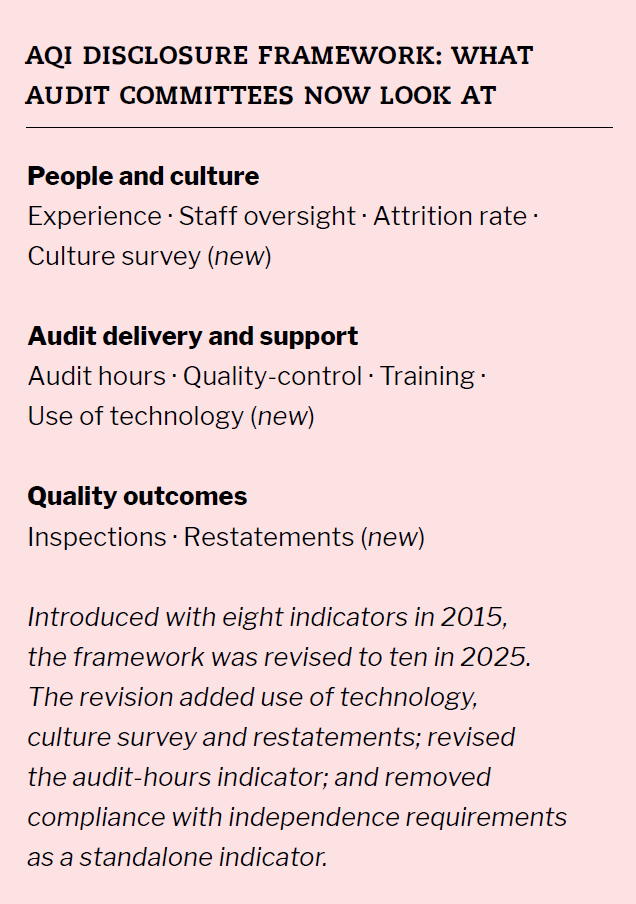
Box 1: The expanded set of AQIs from eight to ten, following a revision of the AQI Disclosure Framework in 2025.
The revised framework shows that the AQIs have remained in use and have been reviewed as audit practice has evolved. ACRA’s repeated engagement with Suwardy across the adjustment studies and the AQI review also points to a sustained professional relationship.
WHAT BECAME POSSIBLE
The most direct evidence of change lies in the use of the AQI framework. In ACRA’s 2025 review, 83% of the audit committees surveyed were aware of the framework and had considered the recommended indicators when measuring and evaluating audit quality. Experience was the indicator referred to most often, followed by audit hours and staff oversight.
This does not tell us whether committees appointed a different auditor as a result, or whether audit quality improved because of the framework. It does, however, show that many committees were looking at a broader set of factors than price and reputation when considering the quality of an audit. For audit firms on the other side of the conversation, the framework provided a consistent way to explain the people, time and controls supporting an engagement.
The adjustment studies made a different contribution. Their impact is less easily traced to a particular decision or regulatory measure. They produced the first aggregated view of corrections being made during audits of Singapore-listed companies and showed what these patterns might reveal about the wider financial reporting process. ACRA’s own account confirms that the first study informed its decision to focus attention further upstream.
ACRA’s decision to engage Suwardy again for the second adjustment study and the ten-year AQI review suggests sustained confidence in his ability to undertake sensitive, practice-facing research.
WHY PRACTICE-LED RESEARCH WORKS DIFFERENTLY
The work began with a practical problem faced by the regulator and the profession: how to understand patterns in commercially sensitive audit adjustment data without compromising the confidentiality of firms and their clients. Addressing it required academic analysis, but access to the data also depended on professional relationships built over many years and confidence in Suwardy’s expertise and independence.
The two strands of work made different contributions. The audit adjustment studies gave ACRA and the profession sector-wide evidence about recurring reporting errors and where they were being corrected. The AQI work helped translate a broad concern about audit quality into a framework that audit committees and firms could use in their discussions.
Neither strand provides a complete measure of audit quality. Good auditing continues to depend on professional judgement, scepticism, firm culture, regulatory oversight and the quality of each engagement. Similarly, the evidence does not establish that the framework changed auditor appointments or improved audit quality. What it does show is that audit committees now have a broader and more consistent basis for discussing quality, while the adjustment studies gave ACRA a clearer view of patterns across listed companies.
The ability to examine its own practices is an important part of sectoral resilience. It enables a sector to identify recurring weaknesses, learn from shared evidence and adapt as risks and practices evolve. Suwardy’s contribution lies in helping create the evidence and trusted arrangements that support this kind of self-examination within Singapore’s audit and financial reporting ecosystem.
Themin Suwardy
is Associate Professor of Accounting (Practice) at the School of Accountancy at Singapore Management University. His work spans audit and financial reporting quality, professional education and practice-led research. He has held leadership and advisory roles across Singapore’s accountancy profession and has worked with regulators and professional bodies on audit quality, governance and financial reporting.
For a list of endnotes to this article, please click here.