

Across Asia—and increasingly around the world—we are entering what can only be described as an age of impact. Organisations are no longer judged solely by what they produce, but by what changes as a result. Growth remains important, but it is no longer sufficient. Stakeholders—investors, policymakers, partners and the public—are asking a more demanding question: what difference does your work make, and how do you know?
This shift is not a passing trend. It reflects a deeper redefinition of performance. Impact is not an add-on to strategy, nor a retrospective narrative assembled after the fact. It is increasingly expected to be designed for, measured, communicated and, crucially, evidenced. Across sectors, we see a convergence around three expectations: clarity of purpose, discipline in execution and credibility in demonstrating outcomes. Together, these are reshaping how organisations operate and are held accountable.
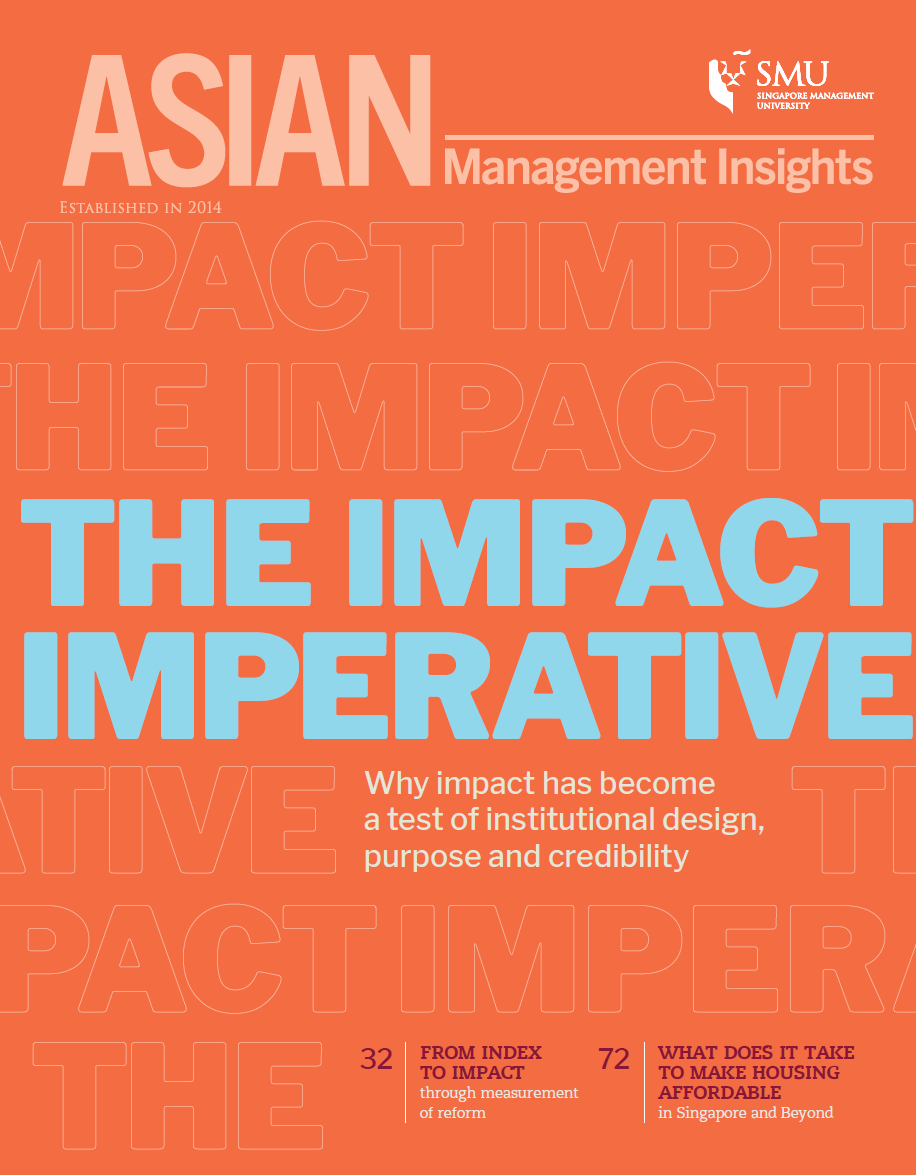
This issue of Asian Management Insights explores how that shift is unfolding across Asia’s distinctive institutional, economic and social contexts. What emerges is not a single model of impact, but a set of evolving practices: often pragmatic, sometimes contested and always shaped by real-world constraints.
One theme that runs through the issue is the growing centrality of measurement as a driver of change. Edmund Malesky describes how Vietnam’s Provincial Competitiveness Index (PCI) uses systematic, credible measurement to reshape behaviour at scale. By grounding assessment in the lived experience of firms and making performance visible and comparable, the PCI has helped turn governance from an abstract aspiration into a competitive, evidence-based process—one that influences reform, investment decisions and policy priorities over time. In a different vein, Robert Klitgaard reminds us that measurement is never neutral: it shapes incentives, behaviour and ultimately outcomes. The challenge is not simply to measure more, but to measure in ways that illuminate rather than distort, and that strengthen accountability without encouraging performative responses.
A second theme is the movement from commitment to integration. Sustainability, long treated as a parallel agenda, is increasingly embedded within core decision-making. As Helge Muenkel of DBS reflects in our conversation, sustainability must become “the cake itself, not the icing on the cake”—fully integrated into risk management, capital allocation and organisational incentives. This reflects a broader shift: impact is not achieved through isolated initiatives, but through the alignment of systems, incentives and everyday decisions. Across several contributions, we see organisations grappling with what it means to move from statements of intent to sustained, system-level change.
A third theme is the rise of credibility as the new currency of impact. In a crowded and often noisy information environment, organisations are no longer rewarded for activity alone. They are expected to explain outcomes clearly, acknowledge limits and ground their claims in evidence. As the Practitioner’s Guide in this issue makes clear, the test of impact is not visibility but explanation: the ability to connect intent, action and consequence in ways that stakeholders can trust. This marks an important transition—from communication as promotion to communication as accountability.
These themes are reflected across the contributions in this issue—from governance reforms and measurement systems to corporate strategy, sustainability transitions and organisational practice. Taken together, they point to a broader transformation. The age of impact is not defined by a single tool or framework, but by a change in expectations. It is an era in which organisations must operate with greater intentionality, where performance is judged over longer horizons and where credibility depends on the disciplined linking of purpose, action and evidence.
This issue also introduces several new features that reflect our editorial direction. Impact Spotlight highlights concrete cases of researchers or organisations translating ideas into measurable change, while In Motion tracks emerging developments shaping the impact agenda across sectors. Both bring readers closer to practice—to what impact looks like as it unfolds in real time.
At Singapore Management University, these questions are not only analytical but institutional. As we continue to develop our approach to being a high-impact university, we are learning alongside the organisations and leaders featured in these pages—working to better align research, education and engagement with meaningful societal outcomes in ways that are rigorous, credible and contextually grounded. This publication is part of that broader effort: a space to convene ideas, share emerging practice and contribute to a more informed conversation about impact in Asia and beyond.
Before closing, I would like to acknowledge the remarkable stewardship of this publication by Dr. Havovi Joshi and her team. Over a run of 27 issues, they have built Asian Management Insights into a thoughtful and distinctive platform for ideas that matter to Asia’s leaders. It is a privilege to build on that foundation, and I extend my warmest congratulations and thanks for their dedication and vision. I would also like to acknowledge and thank the members of the previous Editorial Board for their contributions over the years.
As we take the magazine forward, our ambition is to deepen its role as a forum for understanding how organisations can create meaningful, lasting value in a complex world. The age of impact presents both an opportunity and a challenge: to move beyond aspiration towards disciplined, evidence-based contribution. It is a demanding standard—but one that, increasingly, defines what it means to lead.