

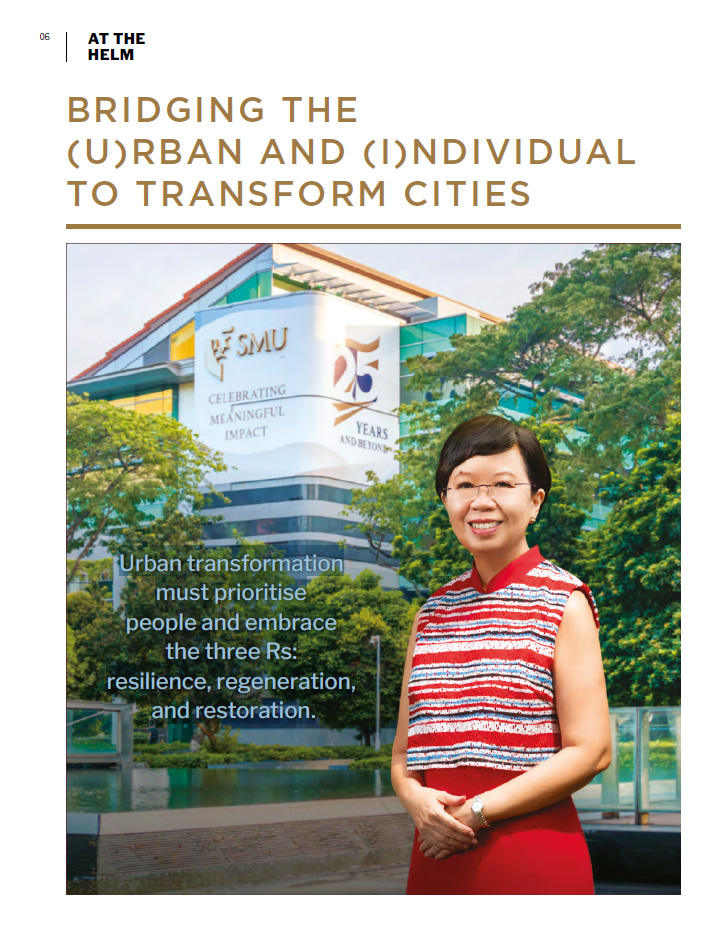
Urban transformation efforts are often focused on infrastructure and technology issues, overlooking how the individual experiences the city. Singapore Management University (SMU) President Professor Lily Kong champions the translation of research on Asian cities into usable insights that make positive impact on human urban experience.
Your research has spanned a range of areas, from inter-communal relations to cultural policy, smart cities, and more. At the same time, you have undertaken significant university leadership roles. What have been some defining moments, both highlights and challenges, that have shaped your perspective as a scholar and leader?
While there have been many such moments, three in particular come to mind. The first was when I was still a PhD student, just three months into my candidature. I had written a literature review to inform my thesis, and it included setting the agenda for research in my chosen area. One of my supervisors read it and suggested that I should submit it to Progress in Human Geography, a top journal in the discipline. No one in Singapore had ever done that, but he encouraged me to give it a try. I sent it in, but first they lost my manuscript, then they changed editors, and subsequently forgot about it! I had no idea something was amiss because I had no prior experience with such publication processes, and so I thought that this was how long journals took. But then after considerable follow-up, it did successfully get published! This was during the 1980s when people in the social sciences in Singapore were not thinking of publishing in such top-tier journals yet. My colleagues in the geography department at the National University of Singapore subsequently said to me that it was pivotal for them to see that someone from the department could publish in a journal like that and it gave them great hope that they could do that as well. For me, what was pivotal was the realisation that “this is possible”. It set my ambitions about putting my work out internationally to compete at the highest levels.
The second pivotal point wasn’t a single point as such, but a journey of thinking about why I do research. Truth be told, I had been doing research that followed my curiosity and interests. So, for instance, there was a time I was interested in environmental issues, and I undertook research on young people’s attitudes towards environmental crises. Another time, I was interested in the ways in which music shaped identities, and I undertook research on Dick Lee, a popular singer-songwriter in Singapore, and Xinyao, a music genre featuring Mandarin songs composed, written, and performed by young Singaporeans. In other words, my research was very much investigator-led and I wasn’t really thinking about what challenges the world was confronting and how my research might contribute useful insights. It was, in a sense, inwardlooking, maybe even self-centred. But I then started thinking about the ‘why’ behind the research I did. And so the questions that I began to ask in my research became much more user-oriented. If I am researching religion, as I am doing now, I am keen to explore how that might help Singapore’s Urban Redevelopment Authority (URA) or the Housing & Development Board (HDB) think about the location of churches, temples, and mosques, how to allocate space to them, the implications of relocation and demolition of religious buildings, and so on. SMU’s focus on societal impact from our research came about in part from this thinking. In one sense, it was also because of my leadership and management role in universities, which prompts a policy- and action-orientation that was not there before.
The next milestone – and I hope to achieve it together with the university – is not just to hope for impact or do work that has potential for impact, but to actively bridge the gap between research and its translation. So if I want my research to impact how URA and HDB think, how do I make it readable for them and also proactively get it into their hands? If I am interested in how religious institutions and organisations help with migrant integration, how do I make that material relevant in a palatable way to leaders of religious organisations? Could I, for instance, develop a manual or compendium that they might use to inform their thinking and programmes? That bridging is not something that academics typically think of doing, but in the UK, for instance, where impact case studies have become mainstream, there are initiatives like translation research grants that can help turn the research into a product or a report that can be used by the community. And that is what I am hoping to do more of myself, with the institution in tandem.
You have long explored the cultural dimensions of urban change. How should we understand urban transformation beyond infrastructure and technology? What are your views on the research conducted in this field?
I have found that much of the research conducted in institutes and centres of urban research in Singapore is focused on design and engineering, systems and technology, and much less on how the individual urban denizen experiences the city. That exploration of individual experience is the kind of research I have undertaken in the past and will continue to pursue. It is also a pillar that the SMU Urban Institute has identified as a distinguishing area for us to contribute towards. For example, one could say, we have designed and planned in a particular way, believing that it is going to lead to particular behaviours – but does it really lead to these behaviours? And what are the contrarian experiences that people are actually going through? It is at least as important to understand how the individual experiences urban space as it is to research the technologies to improve these spaces.
The second dimension I would note about urban research is that much of the work over decades has been focused on Western cities. Some years ago, I wrote a piece with collaborators tracing the travel of ideas in urban research. We found that the work that was coming out of other parts of the world, including Asia, was holding up these pieces of research on urban phenomena in Western cities as not just the gold standard, but the hearth of knowledge generation. Hence, research in Asia was being done using the frameworks, methodologies, and questions that were developed in Western contexts – without necessarily recognising that the experiences of cities in Asia may be different. The Industrial Revolution in Europe that was closely linked to the process of urbanisation took decades, but similar transformations are occurring at breakneck speed in parts of Asia now, for instance. And so the experiences, the questions, and the processes need to be thought about differently. One of the earliest examples of this kind of work was by Terry McGee based out of the University of British Columbia in Canada. He was studying Indonesian urbanisation experiences and he came up with the concept, borrowed from the Indonesian language, of the Desakota, which recognised that urbanisation did not happen in Indonesia the same way that it had in Western experiences. The fact that we still hold up his work from 1991 as a beacon suggests how little has developed that is not Western-centric.
My hope is that the work that we do at SMU Urban Institute will contribute to a body of knowledge that is about urban transformation that makes sense in the Asian context, where we recognise that the multiplicities of Asia are not monolithic, that what happens in Indonesia may well be quite different from what happens in China, and we need that granularity of insights.
In your research on smart cities, what are some of the key insights that have emerged?
This research helped provide me with concrete evidence of what I intuitively thought was happening at two levels – that of the individual and at the city.
At the level of the individual, Orlando Woods, the Director of SMU Urban Institute, and I collaborated with our colleagues at the School of Computing and Information Systems some years ago to research how smart technologies for senior citizens living at home could help improve their lives. And in line with the comment I made earlier about how no one is looking at the experience of the individual, we found these amazing, smart, and interesting ways senior citizens were using to circumvent technology because they misunderstood it. And they also did not always use it the way it was intended. For instance, in an experiment with elderly participants, they had been instructed to “press this button if you have an emergency”. But they did not want to press the button, because they thought all the residents in their apartment block were going to come rushing in, which would be very embarrassing. Or they said that when they pressed the button, nobody responded – and you realise that they had not pressed it properly. Or they would find ways to circumvent the intended use of technology, such as when they covered the fall-detection cameras in their homes with towels because they believed strangers would be spying on them, or when they opened the medicine box, removed the pills they were supposed to take at the appointed time, but then threw them away instead of taking them – despite
pre-set alarms that wouldn’t stop until the medication was removed, based on the assumption it would be ingested. Hence, human behaviours often do not adhere to the ways that technology design assumes, and it is imperative to think about how technology is actually being rolled out, and what the user experience of it is, in order to make it really achieve the intended outcomes.
The other insight was at the level of the city, and this came from the literature we had read to inform our research. It was a case study regarding the implementation and use of the Global Positioning System (GPS) to optimise route efficiency for garbage trucks in Myanmar. It should have been a great initiative to increase productivity, but in that context, garbage truck drivers did not appreciate the GPS monitoring their detours because they exist in an informal economy and garbage truck driving is just one of their several jobs. For instance, a garbage truck driver could also be a delivery person and using the garbage truck to double up as his delivery truck. So if he is forced to use the GPS and follow the most optimal route for garbage collection, he loses his other source of income as he cannot make deliveries elsewhere without another vehicle.
Another example is of smart traffic lights, which might be touted as an excellent initiative to manage traffic congestion. But if the city has not addressed the issue of potholes, the vehicle is going to get stuck and the smart traffic light serves little purpose. Hence physical infrastructure is at least as important as smart infrastructure, the hype about smart cities notwithstanding. With such examples, it struck home forcibly that as companies push their smart technologies to Third World countries – especially when they say, “Look, we have implemented it in London or in Singapore” – the same outcomes are not going to be achieved. So somebody has to protect those cities from being persuaded to buy technologies that are not going to solve their problems.
The lessons are clear – we need to think of the impact of technology at the individual level and also take into consideration local cultural and market nuances when designing solutions.
What does urban resilience signify to you, and how can cultural institutions contribute to that resilience?
Urban resilience is often understood in terms of how cities respond to pandemics, natural disasters, or economic disruptions. But it is also critical for us to think about resilient cities as those that look ahead – anticipating, adapting, and proactively finding ways of fending off disruptions. I have used the three Rs as orientations for describing what we need today: resilient, regenerative, and restorative cities.
To begin with, there is quite a lot of interest in resilient cities, but again, it is typically thought about in terms of design and system resilience. For instance, if there is a massive breakdown of the Mass Rapid Transit, is our system resilient? Or does London’s Heathrow airport have a back-up plan when there is a power outage? But resilience needs to be thought about at the individual level as well. How are cities causing stress for individuals in urban life? How do we help them to develop a certain resilience?
For that, let’s think about cities that are restorative. As city living exerts pressures on individual lives with escalating costs of living, pollution, congestion, overcrowdedness, and so forth, there will be mental stresses and physical illnesses, and social isolation. Hence cities need to be designed to be restorative, and that means having spaces that give people respite, whether it is physical respite like urban parks, or mental and spiritual respite, as in religious spaces, spaces of relative quiet and meditation, and so on.
That calls for nature in the city, and this is where regeneration comes in. A city interwoven with natural spaces offers people respite and restoration, and builds their resilience. At the same time, it becomes regenerative itself. In other words, the city is not just extractive. When you contribute to ecosystems that sustain and renew themselves, the city gains greater longevity. A city where everything is pathed and paved cannot regenerate itself; the capacity will become overloaded at some point in time. So we need to think about resilient, regenerative, and restorative cities in the same breath as one ecosystem.
You have written about religious diversity and its spatial negotiation in cities. As cities grow denser and more diverse, how should urban planners navigate competing spatial claims from different communities, especially religious ones? How can the city be made more inclusive for marginalised or transient populations such as migrant workers and religious minorities?
In many cities, migrant populations bring their own religions, which can become a source of conflict. Very often, it is minority groups that bring their own religion and their own religious buildings that are the source of conflicts, for example, Muslims and Hindus in some Western cities, when predominantly white neighbourhoods push back on applications to planning authorities for a mosque or temple to be established in their backyard. The conflicts may also extend to other affiliated buildings of those religions, such as religious schools.
About three decades back, when I did this work on inter-religious and religion-state relations in Singapore, I held up a model where we had successfully navigated a very tight city to nevertheless develop a harmonious coexistence through careful planning and management. When I presented my work at conferences, the response from scholars, particularly from Western liberal democracies, was often along the lines of, “That’s authoritarian Singapore. You make people do things,” and they wouldn’t think about Singapore’s approach as a solution. As the decades wore on, and I continued to do this work and present it at international conferences, I found that other scholars were saying, “Maybe we need to learn from Singapore” – because they were beginning to see these tensions come to a head elsewhere.
How did we manage to relocate or even demolish religious buildings and not get people up in arms? There are different paradigms of belief about religious buildings. While an urban planner sees it as a particular urban function that could be fulfilled somewhere else, to somebody who is religious, that’s sacred ground. So how can you remove and transfer it somewhere else that doesn’t have the sacrality? How could you even just demolish a religious building altogether without a replacement? And how is it that there is no riot in Singapore as a consequence?
The research I was doing investigated how, at the level of individuals and communities, they conceive of sacredness in space and how they navigate between different value systems that they are brought up with. On the one hand, there’s sacrality and sacredness; on the other hand, there’s pragmatism and functionalism. On the third hand, there’s the value of modernism and modernity having come through a society that was struggling without proper roofs over their heads. How do these different value systems come into play for individuals such that they are willing to accept such displacement of their religious space?
What I found was that the Singapore government adopted different methods of persuasion and explanation. First, it would call on parts of religious texts and religion to help the individual come to terms with loss. For instance, Buddhist beliefs state that one should not get attached to physical objects. Second, the government also appealed to the larger good, explaining that if moving a religious building could make way for HDB flats, imagine the large number of people who could be housed there – and is that not what religion is about, to think about others? In this manner, religious texts and beliefs were used to help explain the need for practical and pragmatic urban planning decisions.
Third, many individuals privatised religious space; they used the altar at home as a replacement for the collective altar in the temple. Some dedicated the storeroom in their HDB flat entirely to religious use. Others renovated the whole apartment along a symmetrical axis as often seen in religious spaces – despite conceding on the original design that sought to optimise the use of space. So the principles of pragmatism that needed to be compromised for sacred principles were taken into the home. I found it fascinating that a certain micro-geography of religiosity gets practised in the home where the macro-geography of the larger temples or churches are located were out of their control.
What role should universities play in driving impact and shaping the future of cities? How can SMU as a city university contribute to the transformation of its surrounding cityscape?
For this, I take the example of New Haven and Yale University. Crime in New Haven in the late 1980s and 1990s was quite bad but it has improved significantly over the decades. What happened was that Yale’s longtime president, Richard Levin, bought up buildings near the university, and bit by bit, all these buildings were turned to university use; as a result, crime rates came down. That is a very significant way of transforming the city.
There are less dramatic ways perhaps. At SMU, our students have been doing community service work for 25 years, which translates to over four million hours. It has been wonderful to see their efforts, but if we could channel more of those efforts to particular causes or precincts, we could actually see not just the activity but also the impact. So I think we can be much more intentional in inspiring our students to make a difference that way. Our colleagues in C4SR (Centre for Social Responsibility) are thinking about adopting a precinct and making a difference through our partners and projects in the precinct. All that is part of the five-year journey of SMU’s next strategic plan.
We have also done so many SMU-X projects in which students collaborate with public, private, and people sector organisations to solve actual challenges. We know the positive learning impact they have had on our students, but I ask myself, “What has the impact been on our partners? How have we made a positive difference to them?” I believe about 60 to 65 percent of our SMU-X projects are with small and medium enterprises, and many need help. We can be more intentional about tracking and evidencing our impact more conscientiously.
As for our faculty, if they sit on government committees and corporate boards, how have they contributed to making a difference? What is the impact of their research on business, government, and society?
And finally in our partnerships, if we partner with a company or an institution and our research contributes to how they think about doing something differently, we should be capturing that impact too.
If you were entering university as a freshman today, in this era of global flux and urban change, what advice would you give your younger self?
First, learn broadly and read broadly. Don’t get me wrong; depth is absolutely important, and you have to develop depth and rigour. But also take courses from different disciplines. You have to learn broadly because the challenges of the world require different perspectives to be brought to bear on that challenge. If you want to solve something in the workplace and in your life, you are going to have to draw from different perspectives.
Second, you are also going to learn how to learn precisely because the shelf life of knowledge is so short. If you think you have learnt everything, you are going to realise that some of that is going to become obsolete and you will have to learn new knowledge and skills. So it is critical that you learn how to learn when the professor is no longer there in your learning journey.
Third, recognise that learning takes place outside the classroom, so embrace the opportunity to do many things outside the classroom. Whether it’s to chair the freshman orientation committee where you learn how to work with people and lead them, or try your hand at a startup even if you don’t really think you want to be starting your own business, do it because it helps you to learn something from scratch. Definitely go overseas and see the world because you are going to work with people from other countries at some point in time, and perhaps even work in another country.
So I would say there are three things. One, have breadth in addition to depth. Two, learn how to learn, and recognise how you learn. And three, please avail yourselves of all the opportunities outside the classroom because you’re going to learn so much about how to work with people, manage conflicts, negotiate and persuade, and so forth, and all of this is going to stand you in really good stead later in life.