

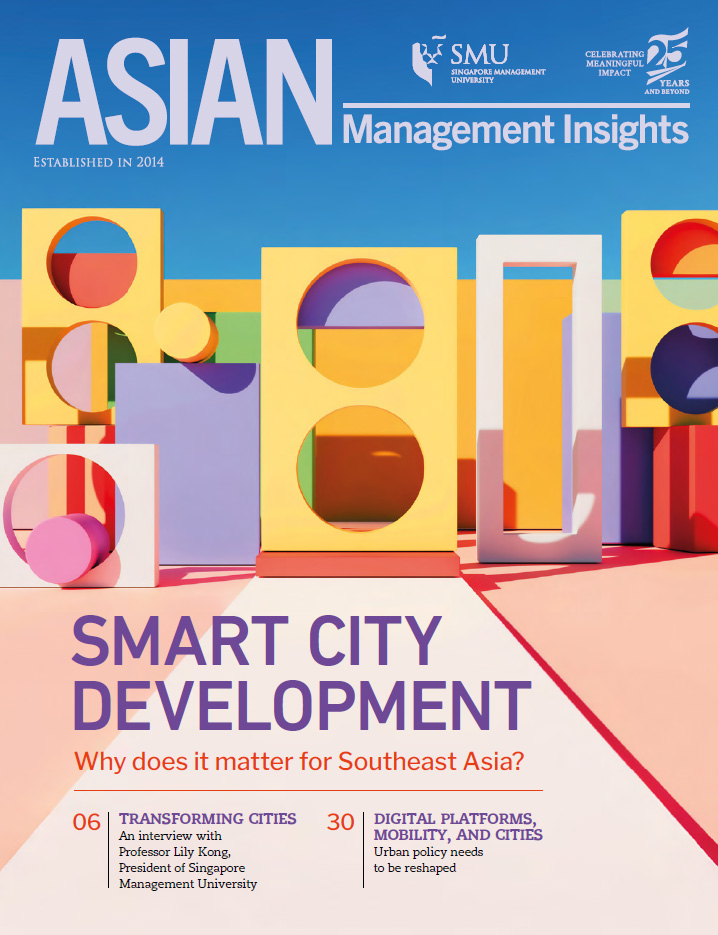
The call for urban transformation has never been more pressing. The United Nations Development Programme (UNDP) notes that while cities produce 80 percent of global GDP (gross domestic product), they also consume 75 percent of global energy supplies and account for 70 percent of global carbon emissions. More importantly, the pace and extent of urbanisation have led to a lamentable and well-known litany of worsening problems: traffic congestion, inadequate infrastructure, unaffordable housing, overcrowding, and social tensions borne of yawning income inequality.
More than half of Southeast Asia’s population reside in ever-expanding megacities, many of which are focusing primarily on design and engineering to address the manifold issues. Singapore Management University (SMU) President Lily Kong argues that urban transformation should instead consider the needs of those whom the technology is meant to benefit – the individual. In essence, efforts to remake the city should embrace the three Rs: resilience (consideration of how cities cause stress), restoration (offering of space to provide respite), and regeneration (provision of green spaces that help restore individuals to their original state).
That is not to say there is no room for smart city solutions, which the region’s biggest cities such as Jakarta and Bangkok have implemented with various degrees of success. Orlando Woods and Liyana Doneva observe that the success of these smart city initiatives to make urban living more equitable and sustainable has been piecemeal at best, and suggest that smart solutions must first be sensitive solutions: responsive to local contexts, grounded in available resources, and attuned to community needs.
Meanwhile, in this issue’s ‘Pulse Point’, Eric Pedersen notes that while the wave of ESG-focused investing during the COVID-19 pandemic has ebbed somewhat, all climate risks eventually translate into financial risks and accounting for ESG will deliver stronger long-term returns.
That way of thinking is aligned with EU sustainability legislation which requires firms to conduct due diligence to detect and prevent instances of environmental harm or human rights abuses. Recent cases against big-name companies have demonstrated the risks of litigation and reputational damage. Adolf Peter thus proposes an incentives framework to achieve net-zero, and urges firms to establish due diligence frameworks before such legislation comes into effect.
Moving on to the often misunderstood private equity (PE) world, Yin Wang and Steve Balaban debunk some of the enduring myths of this asset class and assess if the recent record transaction volumes in the secondaries market signal a long-term shift away from the venerable Yale Model, while offering some practical advice for PE investing.
Bank CEOs who have experienced financial turmoil are on the lookout for trouble. Gloria Yang Yu found that bank executives who experienced the 1980s Savings & Loan crisis managed their banks more conservatively during the 2008 global financial crisis (GFC), and delivered superior performance. As such, she proposes that financial supervisory bodies should consider crisis experience when making bank leadership and governance decisions.
John Lim made a big bet on China in the wake of the GFC and effectively saw his investments double in value annually for over a decade. The co-founder of ARA Asset Management realised his entrepreneurial dreams at a relatively late stage in life when he turned 45, and in the process changed the Asian real estate investment landscape. The secret of his success: deep domain knowledge.
Warehouses are part of any real estate investment strategy, especially in the global manufacturing and logistics hub that is Southeast Asia. Given the ongoing tariff situation and the region’s reliance on an ageing workforce, the time is ripe to digitalise traditionally manual warehouse operations. Toh Wei Kwan, Lim Bing Qian and Choo Wee Tong lay out the technology and strategy needed for effective warehouse transformation.
The Indian truck industry could use some technology to forecast demand accurately. Where the subcontinent’s truck producers struggle with inconsistent purchase patterns and policy changes, effective use of data and innovative sales strategies can make a big difference. Debjit Roy, Anupam Agrawal and Shubham take a deep dive into recommending strategies that can fix India’s truck demand-supply mismatch.
While on the topic of mobility, Shauna Brail notes that urban mobility and infrastructure are being reshaped by digital platforms, especially through ride-hailing, delivery, and micromobility services. She articulates the strains placed on public infrastructure by the unregulated growth of digital mobility, and the resulting changes in the demand for public spaces.
Blue Bird, the biggest taxi company in Indonesia, partnered with ride-hailing giant Gojek as it pursued twin transformations involving sustainable growth and digitalisation. In this issue’s ‘Case in Point’, Yuanto Kusnadi and Wee-Kiat Lim detail how Blue Bird realised its Mobility-as-a-Service vision while making a big bet on electric vehicles, and delivering innovation, efficiency, and profitability.
Blue Bird’s efforts will play a part in solving Jakarta’s legendary traffic congestion, which leads us to where we started: the need to transform Asia’s increasingly crowded cities. In ‘A Walk through Asia’, Shoeb Kagda muses: will the region’s megacities become urban jungles, or could Asia transform its cities into sustainable and resilient urban centres?
As we conclude this issue, I would like to express my gratitude for the privilege of being part of this publication since its inception in 2014. After a rewarding journey of 27 issues, my team and I at SMU’s Centre for Management Practice are pleased to pass the baton to Scott Fritzen, SMU’s Vice President (Impact), who will take over as Editor-in-Chief of Asian Management Insights. We wish Scott and his team every success and look forward to reading many more insightful and impactful issues in the future!